Showing posts with label Osprey backpacks. Show all posts

Friday, 7 April 2017

Nat and James Run Their First 100 Miler!

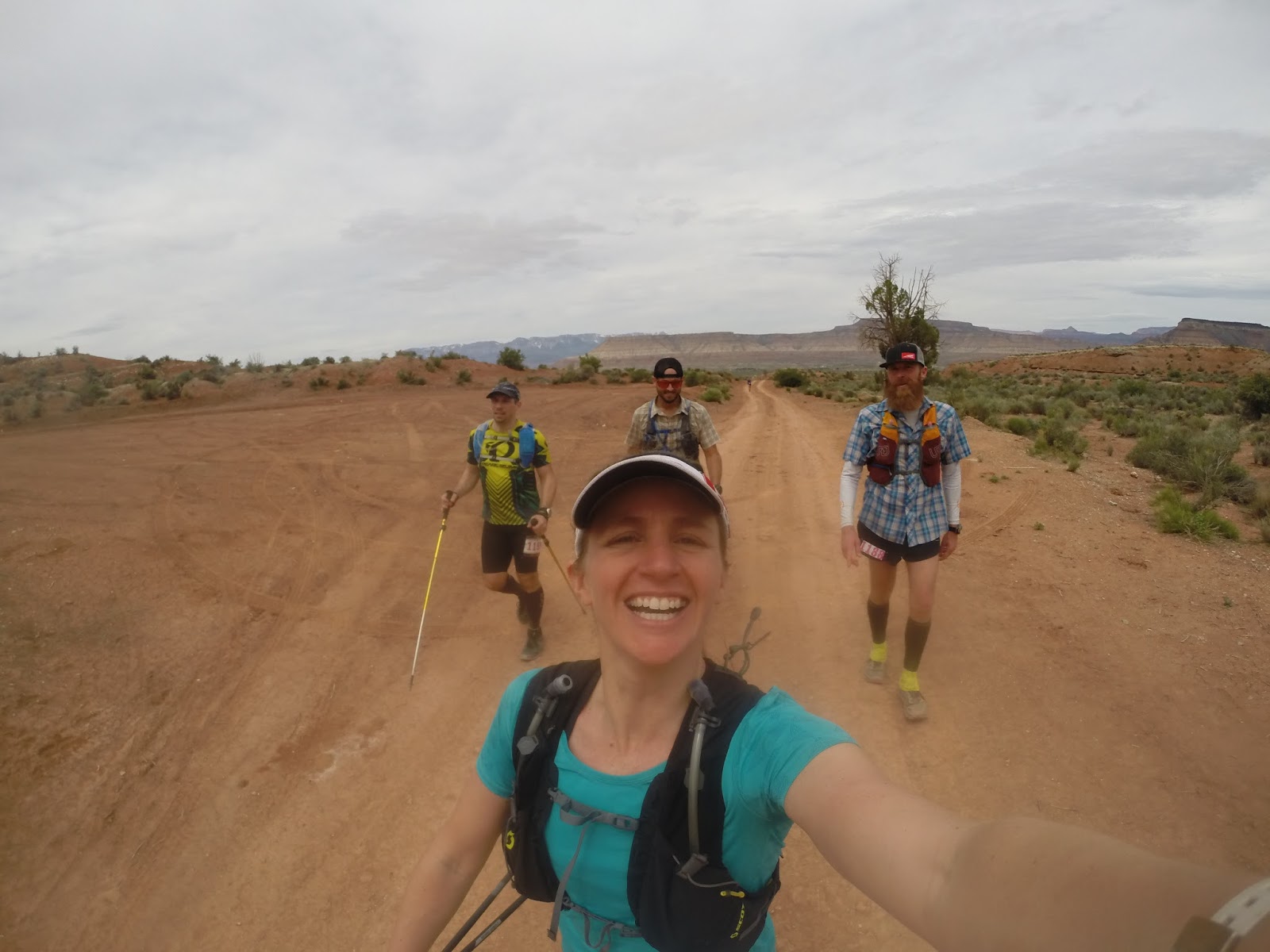
On April 7th Nathalie and I (James) lined up early in the morning for our first 100 mile (160km) ultra. Following our 120km ultra in France last year (and Nat’s 3rd place finish among the women), Nat became interested in the idea of trying to qualify for the Ultra Trail du Mont Blanc (UTMB), one of the pinnacle ultra-distance races in the world. With the limited options for qualifying races and trying to work around our AR schedule, we landed on the Zion Ultra, a race just outside of Zion National Park in Utah. Given the long winter in the Ottawa-Gatineau area, training for a 100-mile ultra in April is not an easy thing to do. We did the best we could, combining snowshoe running, trail running on snow (when possible), road running, and alpine ski touring (a great workout for the climbing muscles). But I could not help being quite worried about entering such a long running race under-trained, and the risk of injury that this might pose for both of us. Nevertheless, we lined ourselves up for the 6:00am start, not really knowing how things would go.

The race basically featured 4 steep climbs up to the top of different mesas (flat top mountains), where we would do one or more loops, often along the edge of the mountain, making for some very scenic views along the way. There was not a ton of elevation, but it almost all occurred in 4 climbs. The first of these was about 3km in the race. Nat and I both started out near the front of the pack of  about 250 racers, not wanting to get caught in the traffic jam that we’d been told occurs part way up the first climb where there’s a short rope section up a steep rock face. As we ran along at a comfortable pace, Nat was all smiles, commenting “I wish adventure races all started this slowly!” After a while I pulled away a little from Nat as we continued to climb. I was feeling good and the pace was reasonable. We both thought that this was the last time we would likely see each other before the end of the race, so we wished each other a good race and parted ways.

Around the 35km mark, something went very wrong for me. One minute I was feeling great and the next minute my body was cooked. I’ve bonked before and this didn’t feel like a bonk. I’ve been dehydrated before and this didn’t feel like that either. It just felt like I hit a wall without any warning and very early into the race. It didn’t make any sense to me, but it was very real and I needed to do something about it. We were on a very flat smooth rock section of the course, yet I still couldn’t even jog. My hunch was (and still is) that a few months of work and life related busy-ness and stress (some good and some not so good - but the body still registers it all as stress) caught up to me. At that point, since I was in the middle of nowhere, my only choice was to walk to the next aid station. So I walked the next 5 or 6 kms to the aid station, expecting that Nat would pass me at any time. Once I got to the aid station, I decided I would wait for Nat to arrive and then try to run with her. If I couldn’t keep up, I would just try to put-put along to see if I could just finish the race.

A few minutes later, Nat arrived with a concerned “what the hell are you doing here???!!!” when she saw me (I found out that this was because she originally thought I had stopped on purpose to wait and run with her). I explained the situation and off we went together. I quickly learned that Nat had been quite busy during the first 40km… busy making trail buddies. It seemed that every time we passed or were passed by somebody, Nat would say “this is my new friend (insert name here)” and they would start talking like old friends...


Despite still not feeling well, I was able to keep pace with Nat, although I could tell I was working harder than she was most of the time. She was moving along at a nice steady rhythm and looking strong the whole time. The course was filled with amazing views, excellent and somewhat technical single track, double track, wide open smooth rock flat mountain top trails, and a few long gravel road sections, making for a nice variety.

At about the 90km mark was a steep descent to an aid station only to return up the same way we came down. We started down the rocky technical downhill and Nat led the way, setting a great pace. I struggled to keep up as she continued to gain speed and confidence as we bombed down the mountain. It seemed that the further we got down the mountain, the stronger and faster Nat got and the more I struggled. The aid station at the bottom was both a literal and figurative low point in the race for me. I struggle to remember a time I’ve felt this bad in any long distance race. I was spent and not entirely clear on why or how to make it better. I ate and drank and just tried to calm my body down, but things were not getting better. I suggested to Nat that she should just head out without me, as we guessed that she was likely in the top 5 women at this point,  to which she kindly (but firmly) informed me that she wanted to stay with me and help me keep going, as long as I was willing. So I asked her for a few more minutes of rest before heading out to the big climb back up. As we finally started to climb back up the mesa, we soon saw 3 women coming down to the aid station. I felt bad for Nat, as I knew I had cost her an extra 10 minutes or so at the aid station and now there were a few women hot on her heels. Surprisingly, I felt better on the climb out than I had felt on the descent, so I tried to pick up the pace a little to get some of that time back that we had lost, while taking a few short breaks as we climbed.

Night fell quickly as we continued on this climb. I slowly started to feel better as we kept a quick but steady fast-hiking pace in the somewhat technical single-track trails. I felt like we could make good time in the night as it’s something that we are quite used to doing in AR. So I just focused on moving forward without pushing myself into a big energy deficit. Meanwhile, Nat just plugged away, always looking strong and being positive and supportive.

We finally arrived at the final “section” of the race, which consisted of 3 loops (red, white, and blue) all leaving and finishing at the same aid station before heading for the finish line. Here we would potentially get a better sense of how many women were ahead or close behind us on the course. As we arrived, Nat spotted one woman who seemed to be already starting the blue trail, meaning she was likely a couple hours ahead. Then out of the dark came an older woman who had passed us before dark – earlier she had gone by us jogging uphill on a gravel road, which was quite impressive considering her age and the point in the race. We assumed that she was completing the red trail, which meant she had put 8km on us. But she informed Nat that she had blown up on the trail and was just coming in to the aid station for the first time (like us). Needless to say, this put a little fire under Nat’s butt. The best description for the rest of the ~40km of the race from this point on is “running scared”. Nat set a fast hiking pace on all the uphills and ran all the flats and downhills - certainly faster than I think I would have done if I were running alone at that point. Each time back into the aid station was just like old times in AR – Nat transitioning very quickly, then checking her watch and impatiently waiting to get moving.

As we finally left the last aid station for the last time, Nat was convinced that the older woman would show up any time and blow past us. We headed out for what was listed as a 10km leg to the finish line. Shortly after leaving we both ran into blister problems. I could feel that the entire tip of my little toe on my left foot was blistered like a water balloon and with each step I could feel the swooshing of the fluid, expecting it to pop with each step (which it eventually did). Nat rarely gets blisters, but had been struggling with very sore feet from the pounding on the road, so she changed shoes when we first got to the last aid station and it appeared that this was not a good decision. Less than 1km after leaving on the leg to the finish her blister popped and it was clearly very painful. She screamed and hopped and stumbled, but refused to stop, fearing that we would be caught any minute by the woman behind. Instead she just focused on watching the kms to the finish roll down on her GPS watch. She had also given me my assignment – keep looking back to see if the other woman was coming.

The next 10kms were a combination of excitement to finish, agony over blisters and the beating our bodies had taken, worry about who may be catching up, and a very narrow focus on just getting to the finish line. Nat continued to check her watch every few minutes, always disappointed by how little ground we had covered since the last time she checked. We passed a few guys along the way, most of whom Nat knew from earlier in the race. Finally we got to the 158km mark of the race. Nat proudly exclaimed that there were only 2kms left and set her focus on just pushing through them. Almost as soon as she made this remark, we encountered a support person coming up the trail towards us. Surely this was a good sign that we were close. He gave us a big smile and a congratulations, saying “Only 2.5 miles to go!” Wait WHAT???? Surely he meant 2.5kms… So Nat asked him again for the distance. He showed us on his GPS watch and then informed us that the race was, in fact, not 100 miles, but actually over 102 miles. Nobody had informed us of this, and Nat was clearly wrecked by this news. She had carefully calculated her energy to give it all she had to get to the finish line and with 2km to go, after nearly 26 hours of running, the finish line moved by nearly 4kms. The next few kms were a combination of exhaustion, frustration, fear of being passed, and physical agony from expecting to be off our feet by then. Each time we would crest a hill, we expected to be able to see the finish line in the distance, only to be met by another hilltop ahead. When we finally did see the finish line off in the distance, the feeling was mainly one of relief. Nobody close behind and downhill all the way to the finish line.

We crossed the line in just over 26 hours and 10 minutes. After asking race officials and getting the printouts, Nat was informed that she had finished 3rd among the women (finishing about 50 minutes ahead of the 4th place woman) and 35th and 36th overall. She ran a great technical and tactical race, took good care of her body, and was even willing to give up her race to help me get to the finish line. While it was not the race I was hoping for, I’m very happy that Nat and I ended up running most of it together, and I know that she enabled me to finish much faster than I could have finished if I had raced alone. It’s truly amazing to witness her pushing her limits and persevere through everything. And although we have raced together in France and now at Zion, I am very impressed by the fact that in both cases she has insisted on doing these ultras completely on her own – refusing to take even a piece of food from me during the race. While the merits of teamwork are endless, there’s something very empowering about knowing you were able to achieve a personal goal all on your own. Congratulations and Thank You to Nathalie for this race.          


Monday, 18 July 2016

James' 2016 Cowboy Tough Race Re-Cap - Racing With Team Adventure Medical Kits


[This is James’ personal recount of his race with Team Adventure Medical Kits at the 2016 Cameco Cowboy Tough Adventure Race. For a full 3-video recap of Team AMK’s race, please see the Team Adventure Medical Kits Facebook page].


About a year before the 2016 Cowboy Tough Adventure Race, I had approached Kyle Peter, the captain of Team Adventure Medical Kits (AMK), about the possibility of racing with their team. Having been an adventure racer for over 12 years, I have slowly honed my AR skills and worked my way up to racing with stronger and faster teams. Feeling as though I am getting into my best AR racing years, I wanted to see if there was an opportunity for me to test and push the limits of my skillset by racing with the top North American team (and also one of the best AR teams in the world). When Kyle approached me about racing the 2016 Cowboy Tough AR, I was game.

My preparation for this race was anything but usual. There were a number of mitigating circumstances (as I think there are for just about every adventure racer) that made things challenging in the final moth leading up to the race: Work commitments that took me out of the country for a few weeks and limited my capacity to train, an illness in the family that shifted the remaining free weekends into road trips to help care for the family member, and trying to recover properly from my first 120km ultra a little over a month before Cowboy Tough. But considering these and other circumstances, I went into the race feeling strong and ready for the challenges that lay ahead.

Oh, and this was the first time in the 3+ years since my girlfriend (and regular teammate) Nathalie and I started dating that we would be racing head-to-head in an adventure race ;-)


ARRIVAL IN CASPER

I was the first on my team to arrive in Casper, Wyoming for the race. I was greeted at the airport by Ted – the father of our “host” family. I’ve never been “hosted” for a race before, and this turned out to be an amazing experience for my team and I. Ted and his family were incredible hosts and went far above and beyond simple hospitality. They became instant fans of AR and of our team – going as far as making posters and meeting us out at various points on the course to cheer us on.

Pre-race organization was, as usual, nearly as challenging as parts of the race. It’s such an exhausting mental exercise to think through the entire race and make sure that you have the right amount of food, clothing, batteries, lights, equipment, and personal items you need for every section of the race – and then to make sure they all end up in the right gear bin (since you will not see them all in every transition area). THEN try to organize these things in the absolute most efficient and minimalistic way possible so that as little time as possible time is wasted in transitions! I knew that racing with AMK was going to be a step up in speed and efficiency for me, so I wanted to make extra sure that I was dialled in and wouldn’t  lag behind in the TAs.


RACE DAY

I woke up at around 4am on race morning feeling a little short on sleep (not surprising or unusual), but excited to get to racing. Finally it was time to put all the preparation to the test. We knew our team would have some stiff competition for this race – no less than 6 teams had a legitimate shot at a podium finish – and because the race was relatively short by expedition racing standards (winning team expected to finish in under 3 days), we also knew that we would have to race it more like a sprint than an expedition race.

One of my favourite moments in adventure racing is the few minutes just before race start. The nervous tension, contrasted with the excitement and anticipation, make for such an incredible feeling; you can’t wait to take on the challenge ahead, knowing full-well (and ever-so-slightly dreading) the amount of physical effort and sheer willpower that will be required to achieve both personal and team goals.


THE RACE IS ON!

I was very happy that the race started with a 7 mile controlled (escorted) lead-out on the bike. This gave me a chance to get my legs warmed up and to just ease into race mode (as opposed to the usual hammer-dropping at the start of most races, no matter how long they are). We started near the middle of the pack and slowly worked our way up near the front before we were set free and the racing started. 
 
We finished the first 50km bike with I believe 4 or 5 other teams all in the lead pack. Our transition was the quickest and put us on the water first – only to take what turned out to be a slower channel right near the start that allowed a couple teams to get ahead of us. The paddling turned out to be quite a challenge for our team; we couldn’t quite keep pace with the leaders (although we weren’t losing major time) no matter what we tried. We attempted to tow early on, but didn’t find much success mainly due to the currents and occasional rapids that made it difficult to keep the boats in-line. I actually ended up paddling in the bow and stern of each of our two boats at one point or another in the paddling sections as we tried to find the best configuration.  it’s extremely hard to get in proper nutrition and hydration when you are in the “chase” boat – the minute you stop for 1 or 2 strokes, you are too far behind to catch back up. 

Mid-way through the paddle, I knew we would be getting out of the boats soon for a short trekking section, so I decided to push hard to try and minimize the gap between us and the lead teams. I suffered quite a bit on the ensuing trek, as it was mainly climbing and running (so again not much time to take in food or water), but was luckily able to recover on the next paddle when I swapped into the faster boat. The next 1/2 hour was probably the most I’ve ever eaten or drank in a 30-minute period on a paddle in a race! It felt good to feel the energy slowly return to my body…
My first low point in the race came from pushing a little too hard in one section to try and stay in the draft of our other boat. As Kyle aptly pointed out at one point in the paddle:

Our next bike was a nighttime singletrack ride. This was a highlight of the race for me, as it’s rare that we get nice singletrack riding in an adventure race, I don’t often get the chance to ride singletrack at night (but I really enjoy it), and all 4 of us were quite strong technical riders. So it was a fun, fast ride for the most part (with the occasional bike pushing sections) and a nice way to break up the long paddling sections. 

After a little bit of time for a sleep due to a dark zone just before the dawn of Day 2, we hit the water with 3 other teams for an early morning re-start on the paddle. This was an uneventful paddle on a beautiful morning… that is, until Garrett and I managed to send ourselves for a little swim on the only really threatening rapid of the race. Technically we made it through the rapid, but we had taken on so much water that we eventually did the “slow roll” into the water. As we floated down the river, Garrett and I were slightly comforted by the sight of other teams ahead of us salvaging their own overturned boats. Nevertheless, it took a fair bit of time and energy to get ourselves to shore – we were however very lucky that when we overturned, everything in our boat got “vacuum-sealed” under the boat and stayed with us until we could flip the boat back over on the shoreline. As luck would have it, the next section of the river consisted mainly of high canyon walls that blocked out the morning sun – and any heat that it could have provided us. So we shivered away for a while until we could finally take advantage of the day’s increasing heat. 


Once off the paddle, we hopped on the bikes for about 70 kilometres of riding, mainly gravel and paved roads. Early on we worked with the Swedish Armed Forces team to try to catch up with Tecnu (who were in the lead), but eventually we pulled away from them and proceeded on our own. I was struggling a little during this bike section. I just felt like my energy output was more than it should be, just to keep pace with my teammates. Something didn’t feel right, but I was unable to identify it at the time. My nutrition and hydration felt fine and my output was steady, but I just felt like I was working harder than I should be. I pushed on, trying to be cautious of not red-lining, while at the same time making sure I wasn’t slowing the team down.

Our first “real” trek of the race was next – a section that started out with a nice clear trail which eventually disappeared and then seemingly randomly (and momentarily) reappeared - but always on the opposite side of a stream that we were following. Needless to say, we did a lot of stream-hopping – which turned out to be my worst discipline of the race! I think I slipped off rocks and stumbled into the stream more times than I successfully crossed it – A great way to make wet feet an issue in a desert-like region!

THE CRUX

Next up could be described as the “crux” of the race – in general for its difficulty for all teams in the middle of the race, but particularly for its role as a turning point in our team’s race. This climb up to Laramie Peak - the highest point of the racecourse (above 10,000 feet) – and back, started out with Tecnu in the lead, about 25 minutes ahead of us. The section was also billed as a “King of the Mountain” section with the team boasting the fastest time from the TA to the summit and back to the TA winning the KOM title and $250. It became apparent to me very early on in this section that our team felt it was time for us to make a move. We held a pretty steady pace on the roads leading up to the trailhead. I then mistakenly assumed that since we would be steadily climbing from the start of the trail to the peak, that we would not likely be doing much running from that point on… Boy was I wrong! Not only did we run anything that was relatively flat, but I found out later that Garrett was encouraging Kyle at the front to run a few extra strides every time the trail dictated that it was time to start walking again. 

Mentally I had to work to get re-focused to push a little harder than anticipated to get to the peak, but I managed to hang on. I was expecting that as we got closer to the top we would see Tecnu on their way back down from the peak and this would give us an idea of the time gap. But about 2/3 of the way up, we spotted them ahead of us on the trail, also on their way up. As you can imagine, this gave me (and the entire team) a much needed boost of energy. After catching and chatting with Tecnu for a little bit, we pushed on to the peak while they gave chase and held on. Both teams arrived at the summit together – a great feeling to reach the top of such a tough and fast climb, and to have caught the lead team! 

We quickly started back down the mountain, trying to get as close to the end of the trail as possible before we would run out of daylight. My renewed energy and enjoyment of technical downhill running made this section quite fun, albeit still quite challenging. There were plenty of loose rocks to make things dicey at high speed.   As it turned out, we were able to put another 15 minutes on Tecnu on the way down the mountain.  

The ensuing bike leg into the night was another low point for me. I was still finding myself working a little too hard for my liking just to keep up. The nighttime riding on long straight-ish roads also caused me to lose focus a bit and revert to a pattern of falling off the pace for a bit and then catching back up, which I think was concerning my team mates a bit. Mari asked me a few times if I was alright, which I took as a polite hint that I needed to get re-focused and get my butt back into the formation or ask for help ;-). Also, I was developing some lower back pain that would force me to try and stretch often as I rode along, again causing me to slow down and then catch back up. I think we were all (as a team) a little unfocused on this section and we didn’t move as efficiently on this ride as we could have. But this isn’t unusual for the second night of an expedition race with little sleep…

After the bike we started into another trek section. As we expected to arrive at the ropes before the dark zone would be lifted (at 5:20am), we opted to do this looped section of checkpoints in a way that would have us ending at the ropes (as these CPs could be gotten in any order). We struggled for about 30 minutes longer than we should have on one CP early in this section which was really our only navigational bobble in the race. But we made some smart decisions in difficult terrain and Kyle quickly got us back on track. We arrived at the ropes about 40 minutes before they were to open, allowing us to get a little more sleep off the clock… You know you are on a team that means business when your captain goes to sleep wearing his harness so that he can be on the ropes less than 5 minutes after being woken up! Once we’d all ascended and rappelled down the ropes, we completed the trek and hopped back on the bikes.

Shortly after staring this bike section, I FINALLY figured out why I had been feeling like I was working so hard (on top of the fact that my teammates are very fast!)… my seat was a fair bit lower than it should be. I felt like a bit of an idiot for not having figured out the problem much earlier in the race, but once I fixed it, I felt SOOOOO much better and stronger… It’s amazing how much difference a few millimetres can make on a bike! While this bike section (and the next) were by no means easy, I felt so much better as my output matched that of my teammates much more closely. This renewed my energy levels for the next relatively short trek in a large, wide-open area strewn with tons of small brush to trip us up. 


We were able to move quite well in this terrain and it felt good to be keeping a solid pace later in the race. Back on the bike again for more long gravel road riding and headwind-fighting, we were beginning to feel the heat of the day catching up to us. We didn’t quite calculate our water needs correctly on this bike section and it caused us to suffer a little on the way up to Muddy Mountain.  But we finally made it and shifted our focus to the last orienteering section of the race. Kyle made quick work of the navigation on this section and we continued to move at a good pace as our thoughts started shifting to getting ourselves across the finish line. The final ride down Muddy Mountain was a little sketchy with plenty of loose gravel, and the ride up and over Casper Mountain was full of anticipation. 

As we headed up Casper Mountain, we were very surprised to see Tecnu coming toward us down the hill. Confusion gave way to empathy as we figured out that they had climbed the wrong mountain first (likely due to a race map that originally had the last TA plotted on Casper Mountain, but for which teams were notified in the briefing of the change). Knowing how hard all the teams (including ourselves) are pushing in any adventure race, it’s easy to imagine (or remember!) the frustration that comes with making a big navigation error and the extra effort that’s needed to correct it – particularly when it involves going up and down two mountains…

THE FINISH

The ride down from Casper Mountain and into the city was generally relaxed. It was nice to not have to race all the way to the finish line and even better to be finishing in daylight! We crossed the line just before 8pm (a little over 2.5 days of racing) and congratulated each other for a great effort on a tough race course against some strong teams. All in all I think we raced a clean, efficient, and fast race. I was not at the top of my game at certain points in the race, but I felt like I did the right things to get myself back on track when needed, and I knew I had the help and support of my teammates available at all times if I needed it. It was a real pleasure to race with such a dialed-in team that does all the little things to be the best they can be. What impressed me most is the attitude and actions of each team member to establish the team as a single unit at all times. There was this constant vigilance within the team about staying close and connected, and doing things together as much as possible. Having studied sport psychology/team dynamics and having been a part of many sports teams over the years, it was great to see the difference this makes both from a performance and personal/psychological standpoint.  


 I felt like I was able to fit in well with the team’s mix of passion, dedication and abilities, along with their calm-but-driven attitude. At the same time, I learned some great lessons about how to be a more efficient and effective racer. I have come away with a clearer picture of what it takes to race at the highest level in AR and I am even more determined to keep getting stronger and smarter in my racing. Without revealing any secrets ;-), I hope to bring back some of this wisdom to my teammates on Team Canada AR when we race at the 2016 AR World Championships in Australia in November.        


Sunday, 13 September 2015

Raid International Gaspesie 2015-2nd coed 4 person team-12th overall

On Tuesday September 9th, Nathalie, Yannick, Jean-François, and Me (James), along with Pete Dobos – the team’s support person for the race - headed out for the Raid International Gaspésie 3.5 day stage adventure race. This was our first race together as a team, although Nat and I had frequently raced against Yannick and J-F, who were regular team mates. After an overnight stop in Quebec City, we finally arrived in Carleton-Sur-Mer to jump right into the usual chaos that is pre-race preparation! There was an opening ceremony Wednesday evening where teams were introduced and we finally got the race maps. We already knew it was going to be a fast race based on last year, but with a sold-out 50 team race and 11 countries represented we knew this would really be a challenging event.


Prologue (From James' perspective):

The prologue started out the same way as the previous year – a blistering 2.1km run along the beach that had us red-lined right from the start. From there it was a short but challenging 1.2km bike ride along the beach and then into some double track trails. With such a short day, we knew there would be no letting up in the pace of the race all day, so everyone pushed as hard as they could. We dropped the bikes and headed up the very steep gravel road system leading to the top of Mt. St Joseph, the highest point in the area. Once at the top, I (James) was designated to head out onto a short ropes course (slackline) while the rest of the team took a quick break to re-fuel. From there it was a very fast descent on foot in single track trails.


At this point, Nat pointed out to the team that eating a meatball sub a few hours before the race may not have been the best decision ;-) but she managed to keep most (but not all!) of it down…  The team then hopped on the bikes again for a jaunt mostly downhill on a beautiful hiking trail. We then faced our first of many water-based challenges in the race – a wetsuit-mandatory canyoning section, complete with slippery rocks, very cold pools of water at the base of waterfalls, an underwater checkpoint, a ropes section, and a crazy 20+ foot drop down a cement “waterslide” (you have to see the video!). Then back on the bikes back into town and onto the 2nd water-based challenge – a 15 foot leap off of a pier into the saltwater and a swim to a fishing boat to retrieve a checkpoint. This was a surprisingly tough little swim with the waves, fatigue, saltwater, and a difficult climb into the boat using only the fishing nets.

Then back on the bikes for a quick ride to the finish line. Prologue completed: We were wet, tired, excited, and amazed at how much action the organizers had managed to pack into only a few hours of racing. This certainly set the tone for the rest of the race. We finished the day in 11th place overall, 2nd in our category.


Day 1 (From James' perspective):

Day 1 was the team’s first full day of racing. The team was excited to get going once again but just like the prologue, the start had us red-lined right from the word “go”. We left from a farm on bikes and proceeded through a trail network. This led to a trekking section that featured a long hike in a very slippery riverbed with fast moving water carrying all of the team’s paddling gear. There was also a rappel down a waterfall for 2 team members, which was completed by Yannick and J-F. While this river trek was slow-going and cold, we were still able to keep a decent pace in relation to our competitors. The river finally led down to the team’s first paddling section of the race. The rivers in the area are shallow and fast-flowing, so the paddling was a constant search for the deepest water around while negotiating small to mid-sized rapids along the way.


We were able to make up a lot of ground on the flatwater sections of the paddle. In fact, we were so fast that we came in ahead of when our amazing one-man support crew – Pete – was expecting us. Pete was around the corner getting the team some hot beverages at the store when we came into the transition. But the team managed to find the support vehicle on our way out of transition, complete with race food, drinks, and sandwiches laid out waiting for us. Then on to a very steep climb on foot and then back down, mainly on trails, which initially seemed pretty straightforward. However, this turned our to be the costliest section of our race: the team lost about 10 minutes due to a navigation error, and Nathalie slipped on a muddy uphill section and smashed her knee pretty badly. While both of these things slowed the team’s pace temporarily, everyone worked well together to get the team back on pace. The next bike was a series of trails, gravel roads, and paved roads which enabled the team to push the pace and draft off of each other.


 The bike eventually led to the final challenge of the day, a short trek that involved crossing a fast flowing waist-deep river to get to the finish line. Another intense, wet, and chilly day completed!


At the end of Day 1 the weather was still rainy which made things difficult for us to repack for the next day knowing that nothing would dry overnight and attempting to keep some things dry for the following day's race.
As soon as we passed the finish line we were told to go to the white tent where some maple toffee and some smoked salmon were waiting for us…that was so great. We also used up a table there with the lights to work on the maps for day2 before heading to a small restaurant to get some warm food.


Day 2 (From Nat's perspective):

The start of day 2 was at 9am but we needed to be there at 8:30am and it was 45min away. We woke up shortly after 6am, made our breakfast and packed up the tent and gears. The results were up. We were still second in our category with the Brazilians and Danish in between 10 to 20 min behind us and we were standing in 12th place overall.

We started on the bike from a big field and soon we were climbing.
My (Nat's) hip and knee were a little sore from the fall the previous day and were of a nice blue-blackish color at that point. The bike section went relatively well. The Danish were ahead and we didn’t know by how far.


We reached the transition and started a trek that was almost all runnable. We were hoping to make up some time but when we got to the canoe transition we couldn’t see the Danish team…they were on the water already.
We spent too much time at this transition trying to sort out the canoes. A lot of them were broken and we couldn’t decide which ones to take.

Once on the water we realized quickly that we wouldn’t make up too much time on that leg because it was a fast moving water leg. It is a lot harder to make up time on fast moving water with rapids than it is on flat water. To our surprise while going downstream we saw the Danish team going back upstream. They had missed the CP and had a couple rapids to paddle back. I think that gave us a little boost and we pushed a little harder.

We finished the paddle without any problems and jumped back on the bikes to get to the next TA which was coasteering section with a little swim and a zipline before getting to the finish.

We ran on the beach and then walked in the water along the cliff. We swam to a buoy and back for a CP then there was more running to the zipline CP. We got there just after a team of two from Canada - MOB. As we were waiting for James and Yannick to do the ropes section we saw the Danish arriving.
We left before they got on the rope and ran to the last CP and then on to the finish. We had a good day overall. We were happy.
Time to sort out the maps for the next day, pack our gear and sleep.


Day 3 (From Nat's perspective):

After spending our last night in bivouac, it was an early morning that was waiting for us.
The start of the race was scheduled at 5:30am from the top of Mt. St Joseph. We were a 35min drive from there and had to be there 30min prior to the start, making it a 3:45am wake up for us. A quick breakfast, packing up tents and gear, and off we went in the truck. We arrived at the top of Mont St Joseph in the pitch dark. The organisation decided to give us an extra 10min to have the first rays of sunshine rising for the start of the race.


The start was a MTB start again. I (Nathalie) am not at ease with mass starts. I feel comfortable once the crowd is spread out, that’s when my race begins.
We knew from the results posted that same morning that we had barely ten minutes on the Danish team (they got a 15min credit for waiting at the canoe section I think) and that today wouldn’t be an easy one. The two person co-ed team from Canada (MOB) had also passed us in the ranking. We were 13th overall. Day 3 had a lot of biking, which is the Danish’s strength, but we would fight till the end for our second place.

We started on the bike, like the other days a little behind lots of people and then played catch up one team at a time. As we reached the first TA to go for a 1km out and back hike to a CP, my bike gears started jamming up and I couldn’t use the 4 easiest gears of my bike. After running to the CP and back James managed to gain back a couple of my gears quickly and we left again.
James helped me a lot during every MTB stage, pushing me up the hills and mentoring me in the more technical sections. We had a couple of hike-a-bike sections on that day, one big downhill bushwacking and a long zig-zagging uphill after a CP in the river.

We knew the Danish Merrell team was ahead of us, but we were catching up. We got to the second transition for a 2km hike to a swimming out-and-back CP. We dropped our bikes and started running. We caught up to the Danish team by the time we got to the lake. Yannick went for the swim and we ran back neck-and-neck with the other team.

We jumped back on the bikes to do an orienteering section. The Danish had passed us in transition and were now ahead. Our orienteering section went well and we were out of there and back on the road to get to another transition. We left that transition 5-10min behind the Danish. It was a short hike through a river to collect a couple of CPs to get back to the beach where we would eventually jump back on the bikes. We decided to bushwack instead of taking the road and the creek down to the river. We hit the river and saw the Danish just ahead of us. It was such a smart move… only problem was we were not sure if the CP was upstream or downstream from where we met up with the river.  So we decided to go upstream a little bit before coming back on our steps. The CP was barely ten meters further downstream from where we had originally hit the river on the bushwhack. We managed that river section very well and caught up and passed the Danish team again.

I knew the next section was a 4.5km ride on the beach and I am a terrible rider in the sand. I was so panicked by that section that I wanted to put as much time on foot on the Danish team as possible to have a buffer for the final bike on the beach. We got to the TA and jumped on the bikes. As I was expecting, the Danish team passed us (I don’t know how they were towing their girl in the sand…it amazes me!) but we managed to keep them in sight till the next and last transition. We went up some stairs, picked up two canoes and were up for a 9km paddle to finish up the race.

We got in the water a few minutes after the Danish but it didn’t take long before we caught up to them. We had a strong last paddle. We did a portage once we reached the barachoi (lagoon) and had a sluggish paddle to the finish line after that due to the shallow water and weeds in there.


We were very happy with how the race went and with our second place co-ed finish (12th overall). It was a great event, fast, but great.

We want to thank the organisation - Endurance Aventure - for such a great event, and also our sponsors for their support. Thanks to Altra Running Canada, Nuun Hydration, Pacific Health Labs, Strongbar Nutrition, Osprey Packs, 2XU Canada, Pearl Izumi, and Natural fitness lab.

And I (Nathalie) want to thank my team for this amazing race!