When Nathalie and I decided a few months ago to do a 50km Ultra trail race in Utah, we thought it would be a great last race leading up to the Adventure Racing World Championships in Ecuador. First, the race is about a month before the World Champs, and second, the race takes place from 7,000ft to 10,000ft of elevation. I have never raced at elevation, so I thought this would be a great way to test myself out and see what it feels like. I figured if things didn't go well, at least I was racing on my own and could slow down or stop if necessary. We knew we were really going to be pushing the envelope for the race, flying into Utah less than 12 hours before the race (although one school of thought is that coming in right before a race at altitude is better than a few days before), but neither one of us could afford to take any time off for this race with the 2 weeks of vacation needed for the World Champs.
The morning of the race was chilly, about 3 degrees, and it was still dark at the start of the race. As the start got closer, we got a little worried that maybe we should have brought a headlamp, but it turned out to be just bright enough to run at a comfortable speed at the start and still see the terrain fairly well. The other most immediate worry was that the first 20km+ of the race were pretty much straight uphill! We started at 7,000ft and climbed 3,000ft right off the start to the highest point in the race. So we knew that the first part of the race would be the most crucial.
I started out in about 10th spot, not wanting to lose touch with the leaders right off the start but also not wanting to blow up either. Quite quickly the field spread out, with the first 5 runners sticking together in one pack and the next 5 (including me) forming another pack. On a few switchbacks, I could see that about halfway up the big first climb, we were about 1 minute behind the lead pack and I couldn't see any runners for quite a ways behind us. I had been running at the back of the second pack up to this point, but was starting to feel quite good as my body warmed up and I got a better sense of the pitch of the climb. I decided to pull ahead of the pack I was running in and try to climb at my own pace. Three of the four other runners came with me for a while and that eventually whittled itself down to only one other runner following my pace. He gave me a few words of encouragement, signalling that he was happy that we were able to pull away from the others. I could see the back of the pack in front of us, telling me that we were making up some ground. I was still feeling good despite pushing a little harder... and then disaster struck.
I felt a little tightness in my calves as I pushed a little harder, but figured that they would eventually stretch themselves out. They didn't. Well, I should say, the left calf didn't. In fact, it got way worse, to the point that I had to fully stop as I felt an intense sharp pain with every step on that leg. Unfortunately, and maybe a little bit fortunately as well, I immediately recognized this pain. I had experienced it twice before in long adventure races when we had to do a very long section of sustained climbing. I don't know exactly what it is, but basically it's a very sharp pain at the insertion point between the bottom of the calf muscle and the top of the Achilles tendon. It causes a sharp pain every time my calf stretches, which is basically every step when you are climbing!
I found myself in a very difficult spot at this point - not dangerous but difficult. I could still walk and could manage the pain by basically pretending that my left foot was in a cast so that I couldn't/wouldn't let it stretch when I would take a step. But it was the question of what to do next that was the most difficult one. So I did all of the things I could think of to try and lessen the pain. I tried to stretch the calf, to stretch my IT band, to completely stop for a bit, and to just try to adapt my gait. Nothing really made it better. But I noticed that by adapting my gait (using the "broken foot" technique mentioned above) it stopped the really realy sharp pain from occurring. Also, it seemed to really be the climbing that was the most painful and when I got to a relatively flat piece of trail I could hobble along without the really sharp pains occurring. I decided that I would make my way to the next aid station and then see from there what to do.
As the aid station got closer, the decision I knew I would have to make got tougher and tougher. On the one hand I knew that it's definitely not good to continue to race when experiencing this type of sharp, injury-type pain. It was definitely clear that something was not quite right in my lower leg and I know first-hand the dangers of trying to push through and injury. On the other hand, I was still able to move forward (albeit a fair bit slower than normal) without making the pain worse and I knew that once I got to the top of the climb that it would be a very long downhill afterward before climbing again. Also (and this was probably one of the most important factors in my decision) I had had this exact thing happen twice before, and continued to race (at a hiking pace) with a lot of pain, but no lasting effects after a few days of rest and some stretching. When I finally got to the aid station about 2/3 up the massive first climb, I decided I would take my time but that I would continue in the race, even if only at a walking pace. So I chatted with the volunteers and took my time having some snacks and taking in some electrolytes. To add insult to injury (literally), despite stopping a few times and only walking the rest of the time, only 5 or 6 runners had passed me, meaning the leaders (including me) had managed to gain a considerable lead on most of the field.
I eventually set off again after trying (unsuccessfully) to do a little more stretching. I wasn't in race mode at this point, but I still felt like I wanted to keep trying to move forward. After all, I could walk, so I decided I would at least walk myself off the course at the point where I decided it was too much. So I just focused on moving forward trying to manage the pain and not make it worse. At the risk of sounding like I'm exaggerating, I would say that every step on my left foot was about a 7 out of 10 on a pain scale with any uphills being closer to an 8. I had many many things running through my head, including not wanting to quit the race, being worried about causing more damage, being worried about long-term effects that could impact the World Championships in a month's time, and plenty of other such thoughts. As all of these thoughts filled my head, I was also doing a little bit of "experimenting" with my pain. As an adventure racer, pain is a very common part of most races, so you always have to try and find ways to try and manage the pain, both mentally and physically. So I treated this as an opportunity to practice my pain management techniques. I noticed that as long as I protected my calf from stretching too far, the pain would not get worse. This amounted to running somewhat stiff-legged on my left side. But I was able to jog at an ok pace on the flats and downhills and struggled a bit more on anything that was uphill. So I just tried to pick up the pace a little with the concession that I would focus on not doing anything that would make the pain worse. I'm sure I looked very awkward waddling and hobbling along, but I was happy to be able to keep moving at more that a walking pace.
The next part of the course was mainly downhill, so I really just had to deal with the steady 7/10 pain with each step, which was not easy, but I was fine with it as long as it didn't get worse. I knew there were really only 2 climbs left in the race after the long descent, so I figured I would re-assess again once it was time to start climbing the next uphill section. The toughest part at this point was that I had to stay very focused on every step on my left - any wrong step that would strain my calf would have literally put me to the ground in pain, so I had to really concentrate on protecting the calf on every step. I was quite frustrated at this point, simple because I really felt great other than the calf pain. I was limited by my pain threshold, not by my physical fitness so the race became much more of a mental one than a physical one - but that's not to diminish in any way how difficult the course actually was as well.
I can't remember exactly where on the middle section of the course it happened, but I encountered a mountain biker coming the opposite way on the trail who gave me a big cheer and said "you're doing great - you're in 13th spot!". I really hadn't been thinking about placements or racing since the pain had started on the climb up, but hearing the biker say I was still in 13th spot - despite all of the walking and the stopping - was somewhat perplexing and yet somewhat motivating. If I was about half way through the race, with presumably the toughest section (the first climb) already done and I wasn't losing that many spot even though I was going slower than I wanted to, then maybe I could still finish the race in a respectable time and placing. I really don't know if this line of thinking was a good thing or bad thing, but it's what made me keep going. I stayed with the logic that my hurting calf was "fine" as long as I didn't do anything to make it worse - which would be signaled by worse pain. I know this isn't entirely accurate (you can do more damage even though the pain is not worse), but in cognitively-reduced race mode, that was the logic I went with. I really don't remember much about the second climb - I think I was just in a bubble staying as focused as I could on each step. The second descent was spent anticipating the final climb. I had it in my head that if I can just get up that final climb, I would be able to just "coast" to the finish line.
Around this time, I took a look at my GPS watch, trying to anticipate when I would be starting the final climb. To my dismay, I had only logged just over 30km, meaning I was still a ways away from the last climb. So I just put my head down and plugged away at the trail in front of me. I finally got to the point in the trail where we started to climb again - what a relief... sort of. I was happy to be starting my last uphill, but I was also at the bottom of the uphill and I knew it would not be easy or short or pleasant. The majority of it was an access road leading up the ski hill. Mentally, for me it's much easier to be in single track trails when climbing because I can't see what's very far ahead, so I'm forced to take things bit by bit. But on this access road, I could see it climb and climb and climb, and I could even see a few runners now and then - WAY higher up the mountain than where I was at. So I knew it was just going to be pretty much straight and steady all the way up to the top of the mountain. I moved forward with a recurring pattern of 10-15 metres of awkward jogging, followed by the same distance of hobbling/walking (and repeat!). Wherever the trail got a little steeper I was forced to hike, this time equally from the pain and the physical fatigue. It was around this point that my speed began to once again be dictated by my physical fitness as much as my pain threshold - so I was going about as "fast" as I wanted to go at that point in the race, which in some twisted, weird way was satisfying. To my complete surprise, I actually began to pass people. I could see by the color of people's race bibs that the majority of them were from the 50 mile race, but I also recognized a few of the 50km runners that had passed me earlier in the race after my calf began to hurt.
When I finally got to the top of the last climb there was the final aid station of the race, which was an Octoberfest celebration! There was German music playing and people dressed in traditional "Octoberfest" type clothing. This was actually the same aid station at the top of the second climb as well, but we reached it from a different side of the mountain. I took in the same things that I had at every other station up to that point - a half of a banana, 3 glasses full of electrolyte drink, and a half package of Cliff Shot Blocks electrolyte chews - and off I went. A jolly man dressed in his Octoberfest garb cheered me on, saying "it's all downhill from here to the finish line!". I already knew that, but it still felt good to hear him say it. For some reason, in my mind I was thinking that going about 7 or 8 km downhill to the finish line would be relatively quick and relatively easy compared to the rest of the race... WRONG! It seemed to take forever to get down that mountain and it didn't really feel any easier, despite the fact that I was going downhill. I think I was just getting physically tired of straining to protect my calf on every other step and mentally I was getting worn down as well. The trail was an endless series of switchbacks slowly making its way down the mountain. At one point I lost focus and kicked a rock and did a Superman dive onto the trail in front of me - thankfully I escaped with dirty hands, shorts, and t-shirt as well as a bruise on my thigh, but no major damage. I got up, dusted myself off and continued to make my way down to the finish. Finally I started to hear the music and the announcer at the finish line, which gave me a little more energy to get this race done. I could see far ahead and behind me for most of the last downhill, so I knew there was nobody I could catch, nor anyone that could catch me, so I tried to maintain my pace, with the relief of not having to push too hard.
When I finally crossed the finish line, I experienced a bunch of emotions simultaneously - relief (both mental and physical), satisfaction (that I managed to finish the race when I really didn't think I would be able to), frustration (at feeling so good fitness-wise, but not being able to push), and worry (that maybe I shouldn't have continued in the race). After chugging a few water bottles full of chocolate recovery drink, I immediately made my way to the massage therapy tent to talk to the people there about my calf. He had me lay face down on the table and started to check things out... You know that something's not good when the massage therapist working on you says "holy shit!". He followed up by saying that he couldn't believe the size of the knot in my sore calf. As he checked around further, he basically told me that everything is very tight from my hip flexor downward, and it's what was causing the huge knot/tightness in my lower calf area. He then proceeded to make me laugh/scream (that sound you make when something hurts so much you just want to kick the person who is pressing on the sore spot!) while he tried to work out some of the crap in there. After my pain session, I made my way to the results tent to learn that I had finished 10th overall. How could I not be pleased with that result considering everything that had happened. I was very happy to have just been able to finish the race, let alone to still place fairly well. But the competitor in me immediately started to wonder how well I could have placed had I been able to push all the way through the race...
The race itself and the location are fabulous. I certainly hope to be able to return to this race again to race it properly and to once again take in the amazing landscape.
2 days after the race, my calf is feeling much better - I have been vigilantly icing and stretching, and it seems to be paying off. I feel extremely fortunate to have escaped any serious fallout (at least it appears that way so far) from the race (altitude-wise or injury-wise) and I am happy that the choices I made during the race paid off - I know that I may not always be that lucky...
Some race photos here.
Saturday, 4 October 2014

Thursday, 11 September 2014
Trouble at the Raid International Gaspésie
Our latest adventure had us traveling to Eastern Canada for the Raid International Gaspésie stage race. We knew going in that this 3.5 day race would not be a typical race for us for a number of reasons. First and foremost, we rarely race in stage races, mainly because there are few of them around. But because this would be a stage race instead of a continuous race, we knew the pace of the race would be much higher - something that didn't necessarily favour us going into the race. Second, we knew that this race wouldn't likely have a lot of tough navigation as it was designed as much as a "multi-sport" race as an adventure race. While this provided for an excellent mix of athletes, again, we knew that this would favour some of our competitors. Third, and most importantly, we knew this would not be a typical race because of the beautiful region where we were racing and the knowledge that the race organizers would take us to some of the most beautiful and rugged places.


For this race, we had three of our usual team members: Stephan Meyer, Nathalie Long, and James Galipeau, but had to scramble in the months leading up to the race to find a 4th person when one of our regulars was no longer able to do the race. Luckily Bruno Haché, an Acadian adventure racer was able to step in and join us for the race. His navigation skills and local knowledge were both an asset to the team for the race.
The first day of the race was a prologue, which consisted of a run on the beach, a bike along the beach and then on roads and trails, a trekking loop on the mountain (with a waterfall CP and a ropes section) a ride back down to the beach, and then a short paddle to the finish. This was an extremely fast day with the overall winners of the day finishing in just over 2 hours. Our team had a decent day on the course, mixed in with a few spots where we lost some valuable time, but all in all we were still in good shape, sitting in 4th in our category at the end of the day.
Day One of the race had us starting with a short trek section to spread the teams out before getting into the canoes for a paddle down the Cascapedia River. Then after a fast-moving river crossing, it was a trek with a Tyrolean traverse along the way followed by a very fast bike section. At the end of the bike section two team members had to swim across the river once again to retrieve the canoes and bring them back to the other shore where teams would have to put their bikes in the boats and paddle to the finish line. Overall it was another decent day for the team, despite some challenges, which included Bruno getting a leg cramp just as he and James set off on the swim across the fast-moving (freezing!) river to get the boats. Nathalie also twisted her ankle during a trek through slippery rocks in a stream, and one of our canoes capsized in a rapid with 2 of our bikes attached to it at the start of the final paddling section. But we recovered well from each of these setbacks and managed to move up to third place in our category at the end of the first full day of racing. The evening after the day's racing was also pretty amazing as we were hosted by the Mic Mac tribe on their land. We were treated to a spectacular display of traditional drumming and dance, as well as fresh salmon with maple syrup smoked on cedar planks inside hollowed out tree trunks. To cap off the night, there was an amazing display of the Northern Lights.
Day Two would unfortunately barely get started for our team before we ran into serious trouble. The race started off with a paddle section, and for our team, this was also where our race ended. It was a very cool morning that had left a frost on the ground and made for some chilly sleeping (or not sleeping!) the night before. Nathalie had been battling a pretty nasty chest cold that started up just before the race, and the cold, rain, and camping of the previous 3 days was certainly not helping things. We started out pushing pretty hard and trying to manage the "bumper boat" craziness that always comes with a mass paddle start. The plan was for our team to use a tow rope to help us to move faster, but this proved to be very difficult for the first part of the paddle with all of the boat traffic seemingly moving in all directions.Once we finally were able to get our boats attached, it was full steam ahead and we pushed very hard to try and make up some lost ground. Unfortunately this exacerbated Nathalie's chest cold and set off an exercise-induced asthma attack less than 1km from the end of the paddling section. The combination of the stress and chaos of the race combined with the anxiety caused by the asthma attack then caused her to hyperventilate, which immediately got the attention of a few thoughtful teams who stopped to make sure everything was ok, as well as a boat with a camera crew on board. It appeared that Nathalie was getting everything under control and the team began to paddle again to try and get to the transition area. But once again her breathing became very difficult, so her boat pulled to the shore so that she could walk the remaining 300 metres to the TA. She was met half way by a crew of medical staff and other onlookers who immediately tried to help restore her breathing to normal. While the medical team was excellent, it seems that having having so many people in close range created more anxiety and unfortunately Nathalie wasn't able to get her breathing back to normal on her own. So she was taken by ambulance to the hospital (despite her pleas to be unbuckled so that she could keep racing!) where she was warmed up and monitored for a brief time before being released. While she was feeling better, the trip to the hospital meant the end of the race for our team. Nat said this is the worst chest cold she's ever had and it actually got worse the following night - she said she's not sure if she could have continued to race hard on the following day even if the team had been allowed to continue. Stephan however did manage to race on the final day with the team from Costa Rica after one of their team mates had to withdraw from the race as well.
Obviously this was not the result that any of us had hoped for, but we can say that we raced hard for the whole time that we were out there on the course. We all agree that a team mate's health is far more important than any race result and we are all happy that Nathalie didn't suffer any lasting effects from the incident (except for the chest cold that doesn't seem to want to go away!). We are all keenly aware of the dangers that we subject ourselves to when we choose to do an adventure race, and we don't take these risks lightly. So when a serious situation does occur, it reminds us how fortunate we are to be able to race hard and to finish most of the races that we enter. And it's also a very big comfort to know that our fellow competitors care enough to stop their race in order to offer a helping hand when something does go wrong.
All we can say in the end is that the race course, the region, the organization, and the medical response were all outstanding - and we can't wait to come back again to take care of some unfinished business...
Here is a video recap of the race: https://www.youtube.com/watch?v=TVFwnKAc7lE
James
Friday, 22 August 2014
Nat & James get more adventure than they bargained for at the Raid Bras-du-Nord MTB race
Always know what you are signing up for. Sounds simple and straightforward right? In most of the racing we do, there is always some element of the unknown, but we (James & Nathalie) admittedly were a little caught off guard while racing the Raid Vallee Bras du Nord Mountain bike race(s) on the weekend of Aug 22-24. I (James) have no doubt that the organizers explained their new format clearly on the website. But when we signed up for the race, we just went on the assumptionr (without reading much on the website) that the race format would be similar to previous years, except that there were 3 stages. Sounded like fun! So we signed up early in the summer.
As the race drew closer, we actually read the race weekend description: a Friday "Night Challenge", an "Enduro Challenge" on Saturday, and the "Evolution Challenge" on Sunday. As we read what these races actually entailed, we became both excited and a little nervous. All 3 races offered a unique and interesting challenge to racers - Friday would be a 2-person night time relay race, Saturday was basically a downhill time trial, and Sunday was more of a cross-country race but with only 3 timed "sections" of the race. All 3 of these formats were new to us, so we just decided we'd tackle the weekend as a new adventure, a great training opportunity, and a change of pace from adventure racing.
As it turned out, the Friday Night Challenge was unfortunately canceled due to lack of participation, but the organizers were great to still offer participants the (free) opportunity to ride a marked course on Friday night at a more leisurely pace. This was a friendly easy-paced ride that allowed us to make the most of the weekend and to get the opportunity to do some night riding. The marked loop was awesome and we had a really fun ride.
Saturday's "Enduro Challenge" is where things got very interesting for us. We were not familiar with the "Enduro" style of MTB racing, which is defined in the following way:
"The most basic definition is timed downhills and untimed uphills. Racing is over a series of special stages and whoever has the fastest combined time after those stages wins. Riders need to get between the stages, often for a set start time."
We would be doing the same (mostly downhill) trail twice with a set start time for the first downhill and no set start times for the second one.
The other thing we were not familiar with for this race was the trail. The race would consist of biking (untimed) up an access road to the start line and then bombing down the "Neilson" trail - the Vallee Bras du Nord's newly opened signature trail - in 1 minute intervals between racers. We had ridden small section of the Neilson a few weeks earlier and found it to be fairly technical compared to the trails we normally ride - only to be told that the section we rode was the "easier" part of the Neilson. This had us both quite nervous. Here's a little video of that easier section of the Neilson trail to give you an idea of some of terrain. Nathalie has been working in improving her technical riding this season, so this trail was a major step up in terms of difficulty for her (particularly at race speed), while I was concerned with racing somewhat blind downhill on a technical trail that I didn't know at all. Nat was set to start 1 minute ahead of me, but managed to convince the organizer to allow her to start in the last time slot to allow her a little more time to run the course without having to worry about people coming behind her.
As I started my descent, I was filled with both the excitement of the race and the nervousness of bombing down an unfamiliar trail. In adventure races, the speeds are much slower generally due to the length of the race, but this was 25+ minutes of red-lining or at the least pushing the limits of one's technical abilities (at least for me!). I also find it extremely hard to race conservatively, so of course I went out way too hard - finding out the hard way that the relatively short uphill section in the middle of the course was longer and steeper than I expected, and that maneuvering my hardtail Cannondale 29er on the 12km course (which I would classify as mostly a downhill course with some cross country terrain mixed in at a few places) was a lot more tiring than I thought it would be. I also ended up in quite a few spots on the trail where, had I known what was coming, I would have gone slower or taken a different line. I found myself making a LOT of mental notes of places on the trail where I would need to be more careful the second time around... I decided to wait for Nat at the bottom of the course so that we could ride back up together to start line a second time. I was expecting her to finish with a look of terror on her face, given how much more technical these trails were compared to where we'd been training, but instead she finished looking quite determined and confident.
After riding back up to the start line, I started my second loop a couple minutes ahead of Nat. Based on the first loop I decided that I would take the second one as a hard training session, and back off a little from race mode, particularly with my long list of mental notes of places to be more careful on the trail. Ironically, letting off the throttle is what actually led to my demise this time around... I seem to have missed on of those mental notes at one particular point in the trail and went over what looked like a rounded boulder on the trail but what turned out to be a "half" boulder - with about a 3 foot cliff on the other side. I had gone over it so quickly the first time around that I more or less jumped off the ledge and managed to stay upright (but just barely), but I didn't recognize this boulder the second time until it was too late (and apparently there was a way around the boulder that I didn't see either) and with my slower speed, I more or less just dropped off the edge of the rock and went right over my handlebars. It was not pretty and to be honest, I'm not really sure how I didn't injure myself and/or break my bike. But there was nobody around and I just got back up, brushed off the dirt and kept going...once again a little slower. The rest of the ride was relatively uneventful and Nat ended up posting a faster second lap and finishing tired but satisfied.
Sunday turned out to be a lot closer to what we originally thought we were signing up for - 40+km of a mixture of incredible single track, fun double track, and a little bit of road to connect them all. Nathalie and I rode the untimed parts of the race course together and then raced the timed sections separately. We both had a good day on the trail and lots of fun.
In case I may have undersold the race, I just want to say that the race itself was excellent - very well run and taking place on some truly beautiful and amazing trails. The format, while not what we expected, was actually very interesting and a nice change of pace. The Neilson is a spectacular trail that I can't wait to go back and ride soon - but not blindly in a race ;-) All in all we got what we were looking for out of the weekend - some challenging technical training in a beautiful place and overall a fun weekend in the trails. What more could you ask for?
(In all the excitement, we didn't manage to take any pictures, but there were photographers on course, so we hope to eventually be able to post some pics of the race)
James
As the race drew closer, we actually read the race weekend description: a Friday "Night Challenge", an "Enduro Challenge" on Saturday, and the "Evolution Challenge" on Sunday. As we read what these races actually entailed, we became both excited and a little nervous. All 3 races offered a unique and interesting challenge to racers - Friday would be a 2-person night time relay race, Saturday was basically a downhill time trial, and Sunday was more of a cross-country race but with only 3 timed "sections" of the race. All 3 of these formats were new to us, so we just decided we'd tackle the weekend as a new adventure, a great training opportunity, and a change of pace from adventure racing.
As it turned out, the Friday Night Challenge was unfortunately canceled due to lack of participation, but the organizers were great to still offer participants the (free) opportunity to ride a marked course on Friday night at a more leisurely pace. This was a friendly easy-paced ride that allowed us to make the most of the weekend and to get the opportunity to do some night riding. The marked loop was awesome and we had a really fun ride.
Saturday's "Enduro Challenge" is where things got very interesting for us. We were not familiar with the "Enduro" style of MTB racing, which is defined in the following way:
"The most basic definition is timed downhills and untimed uphills. Racing is over a series of special stages and whoever has the fastest combined time after those stages wins. Riders need to get between the stages, often for a set start time."
We would be doing the same (mostly downhill) trail twice with a set start time for the first downhill and no set start times for the second one.
The other thing we were not familiar with for this race was the trail. The race would consist of biking (untimed) up an access road to the start line and then bombing down the "Neilson" trail - the Vallee Bras du Nord's newly opened signature trail - in 1 minute intervals between racers. We had ridden small section of the Neilson a few weeks earlier and found it to be fairly technical compared to the trails we normally ride - only to be told that the section we rode was the "easier" part of the Neilson. This had us both quite nervous. Here's a little video of that easier section of the Neilson trail to give you an idea of some of terrain. Nathalie has been working in improving her technical riding this season, so this trail was a major step up in terms of difficulty for her (particularly at race speed), while I was concerned with racing somewhat blind downhill on a technical trail that I didn't know at all. Nat was set to start 1 minute ahead of me, but managed to convince the organizer to allow her to start in the last time slot to allow her a little more time to run the course without having to worry about people coming behind her.
As I started my descent, I was filled with both the excitement of the race and the nervousness of bombing down an unfamiliar trail. In adventure races, the speeds are much slower generally due to the length of the race, but this was 25+ minutes of red-lining or at the least pushing the limits of one's technical abilities (at least for me!). I also find it extremely hard to race conservatively, so of course I went out way too hard - finding out the hard way that the relatively short uphill section in the middle of the course was longer and steeper than I expected, and that maneuvering my hardtail Cannondale 29er on the 12km course (which I would classify as mostly a downhill course with some cross country terrain mixed in at a few places) was a lot more tiring than I thought it would be. I also ended up in quite a few spots on the trail where, had I known what was coming, I would have gone slower or taken a different line. I found myself making a LOT of mental notes of places on the trail where I would need to be more careful the second time around... I decided to wait for Nat at the bottom of the course so that we could ride back up together to start line a second time. I was expecting her to finish with a look of terror on her face, given how much more technical these trails were compared to where we'd been training, but instead she finished looking quite determined and confident.
After riding back up to the start line, I started my second loop a couple minutes ahead of Nat. Based on the first loop I decided that I would take the second one as a hard training session, and back off a little from race mode, particularly with my long list of mental notes of places to be more careful on the trail. Ironically, letting off the throttle is what actually led to my demise this time around... I seem to have missed on of those mental notes at one particular point in the trail and went over what looked like a rounded boulder on the trail but what turned out to be a "half" boulder - with about a 3 foot cliff on the other side. I had gone over it so quickly the first time around that I more or less jumped off the ledge and managed to stay upright (but just barely), but I didn't recognize this boulder the second time until it was too late (and apparently there was a way around the boulder that I didn't see either) and with my slower speed, I more or less just dropped off the edge of the rock and went right over my handlebars. It was not pretty and to be honest, I'm not really sure how I didn't injure myself and/or break my bike. But there was nobody around and I just got back up, brushed off the dirt and kept going...once again a little slower. The rest of the ride was relatively uneventful and Nat ended up posting a faster second lap and finishing tired but satisfied.
Sunday turned out to be a lot closer to what we originally thought we were signing up for - 40+km of a mixture of incredible single track, fun double track, and a little bit of road to connect them all. Nathalie and I rode the untimed parts of the race course together and then raced the timed sections separately. We both had a good day on the trail and lots of fun.
In case I may have undersold the race, I just want to say that the race itself was excellent - very well run and taking place on some truly beautiful and amazing trails. The format, while not what we expected, was actually very interesting and a nice change of pace. The Neilson is a spectacular trail that I can't wait to go back and ride soon - but not blindly in a race ;-) All in all we got what we were looking for out of the weekend - some challenging technical training in a beautiful place and overall a fun weekend in the trails. What more could you ask for?
(In all the excitement, we didn't manage to take any pictures, but there were photographers on course, so we hope to eventually be able to post some pics of the race)
James
Sunday, 17 August 2014
K2O 200km Paddle race
K2O...I registered to that race thinking it would be a great challenge, a 200km paddle race from Kingston to Ottawa as a solo surfski. After a lot of thinking on which class I should register I decided to register as an Adventure class, which meant starting a couple of hours early and having the opportunity to use my support crew not only for food and water but also for carrying my boat around the locks. Indeed along the 200km we would encounter about 22 locks that we would have to portage and we had 32 hours to finish it.

My support crew, Joel Perrera and Peter Dobbos from Breathe Magazine and my partner James all did an outstanding job at support crewing during that day.
As an adventure class I had the option to start either at 6am or 8am. I opted for the 8am start thinking it would give me people to chase. That would be my goal of the day.
We were about 23 vessels all up, 5 in the competitive class and the rest in the adventure class. When I got to the start at 8am I learnt that most people had started in the 6am wave and that we would be only 3 of us starting at 8am.


According to my calculation I should be able to catch the slower people after roughly 14 hours of paddling if they were paddling 2km/h slower than me.
I had a great start but realised very quickly that something was slowing me down. I saw a canoe on the way and asked them to check my rudder...it was full of weeds :(
I had borrowed a think uno max from my friend Jodi. It is a faster lighter and more tippy boat that what I was used to but for speed I thought it would be worth it. The only problem is that this boat was a prototype and they didn't place a weed deflector. I never had this problem before and would realise very quickly that it can wear you down a lot. I made it to the first lock in a good time considering. Joel was ready with food etc. I was first of the 3 who started at 8am and was well determined to go and catch those people ahead.
After about 50km of paddling or so I caught up with the stand up paddle boards (they were two of them). They both one after the other helped me with my weed situation when I could barely be paddling anymore due to the dragging behind the boat.
James had met up with the guys by then and it was good to see him at the locks.
To follow the route I had printed maps of the course and I also had a gps in case I couldn't see the navigational channel to help me find my way.
The first 100km were not straight forward and the gps or maps were necessary. After that it wouldn't be too open anymore and it would become channel like so much easier to navigate.
The open sections with all the big lakes was a little scary. The weather was pretty bad all day with lots of rain but by then the wind had picked up a lot and the waves were starting to grow considerably on the lake. Thanks god the wind was in my back most of the time so I could stay upright.
I started panicking a little knowing that I didn't have my leash so that if I had tipped I could have lost the boat very quickly. There was also no safety on the water which made me pretty nervous.
When I reached the 70km mark I wasn't happy. I was tired and terrified and didn't want to keep on going.
I decided to keep on going after the race director told us it should get sheltered and a lot better after...It didn't..I started what was supposed to be a 30km section without seeing my support crew very very stressed. The waves were bigger and bigger with reflective waves coming from the side and the winds picked up to 60km/h sometimes. I decided to wait in a little bay for the next boat to come and paddled with him as I was more than scared. We paddled together and some of the boats from the 10am wave (the competitive class) caught up to us. After about 5km of bracing I fell in. My PFD wasn't tight enough and I struggled to keep my boat, my paddle and everything else floating around with me. The other kayaker helped me and held onto my boat and paddle for me as I was trying to tighten my PFD. Unfortunately within seconds they were blown away just a little too far for me to reach them. I tried desperately to reach them without success and he couldn't paddle anymore since he was holding on my boat etc...As a last resource I used my whistle and some very nice people came out of their cottage, took their motor boat and went to rescue my boat as I swam to shore...What an experience :(
A pro canoe had stopped at the same place than us and we all decided it was too dangerous to keep on going.
We called our support crew from the cottage and called the race director who told us he was cancelling the race due to the weather.
I ended up doing about 75km in 11 hours (with at least 30 to 45min spent in the water trying to get rescued).
The race director made a tough but right call by calling the race off. If it wasn't for the weather (and the weeds) I think I would have done pretty well. At the last lock I went through I was apparently 15-20min behind 4 boats that had started 2 hours ahead of me so I was catching up.
There will always be next year..and this time I will be more prepared. I will have my revenge!!!
Nathalie
My support crew, Joel Perrera and Peter Dobbos from Breathe Magazine and my partner James all did an outstanding job at support crewing during that day.
As an adventure class I had the option to start either at 6am or 8am. I opted for the 8am start thinking it would give me people to chase. That would be my goal of the day.
We were about 23 vessels all up, 5 in the competitive class and the rest in the adventure class. When I got to the start at 8am I learnt that most people had started in the 6am wave and that we would be only 3 of us starting at 8am.
According to my calculation I should be able to catch the slower people after roughly 14 hours of paddling if they were paddling 2km/h slower than me.
I had a great start but realised very quickly that something was slowing me down. I saw a canoe on the way and asked them to check my rudder...it was full of weeds :(
I had borrowed a think uno max from my friend Jodi. It is a faster lighter and more tippy boat that what I was used to but for speed I thought it would be worth it. The only problem is that this boat was a prototype and they didn't place a weed deflector. I never had this problem before and would realise very quickly that it can wear you down a lot. I made it to the first lock in a good time considering. Joel was ready with food etc. I was first of the 3 who started at 8am and was well determined to go and catch those people ahead.
After about 50km of paddling or so I caught up with the stand up paddle boards (they were two of them). They both one after the other helped me with my weed situation when I could barely be paddling anymore due to the dragging behind the boat.
James had met up with the guys by then and it was good to see him at the locks.
To follow the route I had printed maps of the course and I also had a gps in case I couldn't see the navigational channel to help me find my way.
The first 100km were not straight forward and the gps or maps were necessary. After that it wouldn't be too open anymore and it would become channel like so much easier to navigate.
The open sections with all the big lakes was a little scary. The weather was pretty bad all day with lots of rain but by then the wind had picked up a lot and the waves were starting to grow considerably on the lake. Thanks god the wind was in my back most of the time so I could stay upright.
I started panicking a little knowing that I didn't have my leash so that if I had tipped I could have lost the boat very quickly. There was also no safety on the water which made me pretty nervous.
When I reached the 70km mark I wasn't happy. I was tired and terrified and didn't want to keep on going.
I decided to keep on going after the race director told us it should get sheltered and a lot better after...It didn't..I started what was supposed to be a 30km section without seeing my support crew very very stressed. The waves were bigger and bigger with reflective waves coming from the side and the winds picked up to 60km/h sometimes. I decided to wait in a little bay for the next boat to come and paddled with him as I was more than scared. We paddled together and some of the boats from the 10am wave (the competitive class) caught up to us. After about 5km of bracing I fell in. My PFD wasn't tight enough and I struggled to keep my boat, my paddle and everything else floating around with me. The other kayaker helped me and held onto my boat and paddle for me as I was trying to tighten my PFD. Unfortunately within seconds they were blown away just a little too far for me to reach them. I tried desperately to reach them without success and he couldn't paddle anymore since he was holding on my boat etc...As a last resource I used my whistle and some very nice people came out of their cottage, took their motor boat and went to rescue my boat as I swam to shore...What an experience :(
A pro canoe had stopped at the same place than us and we all decided it was too dangerous to keep on going.
We called our support crew from the cottage and called the race director who told us he was cancelling the race due to the weather.
I ended up doing about 75km in 11 hours (with at least 30 to 45min spent in the water trying to get rescued).
The race director made a tough but right call by calling the race off. If it wasn't for the weather (and the weeds) I think I would have done pretty well. At the last lock I went through I was apparently 15-20min behind 4 boats that had started 2 hours ahead of me so I was catching up.
There will always be next year..and this time I will be more prepared. I will have my revenge!!!
Nathalie
Sunday, 20 July 2014
Finding silver on the Canadian shield at Wilderness Traverse-2nd overall
[My apologies for not getting this race report written up sooner! Amazingly, two weeks have already passed! A few days were just for recovering, then life got in the way. But without further ado, here we go.] A mere three weeks before this race, I was tackling the toughest race I had tried to date, the 4-day Untamed New England. However, being slightly shorter, at 24 hours in length, does NOT make a race easier. In fact, racing with my ‘semi-pro’ competitive team actually made this another really tough race, thanks to the relentless pace, and the taste of podium pushing us hard the whole way.
Two weeks out, we had a good look through the roster, and figured we had a legitimate shot at winning this race, which is one of the toughest fought adventure races in Eastern Canada (if not Canada). It attracts top teams from all around, and this year even had 2 teams from France competing. However, a day later, I noted that a new team had signed up consisting of Benoit Letourneau, Alex Provost, Vincent Meunier, and Liza Pye. Yup, pretty much the dream team, and technically 3 time returning champions. They usually win by huge margins, so victory was FAR from assured, but we had to go in with a strong positive attitude, which we did.
With the race featuring a remote start early Saturday morning, we all converged on race HQ Friday evening for gear checks and race briefings. Maps were distributed around 8:30pm, and were pre-plotted with CPs and TAs. Harper then got to work on the important job of route determining. With tethered laptop we scoured Google Earth and Bing trying to make sense of the terrain to find the ‘hopefully best’ route. In AR, you are always taking a bit of a gamble when the course is predominantly raw wilderness. As the name implies, this race has that in spades. Race director Bob Miller never holds back, spending the better part of an entire year designing a kick-ass course. The asses being kicked of course are the racers’! Back at our hotel room, we wrapped up map prep and gear sorting and were in bed before midnight to get a solid 4-5 hours of sleep before rolling back to HQ to catch buses and start the race, knowing we wouldn’t be back there until sometime the next day (although we hoped for a quick finish by racing hard).
Stage 1: The Paddle
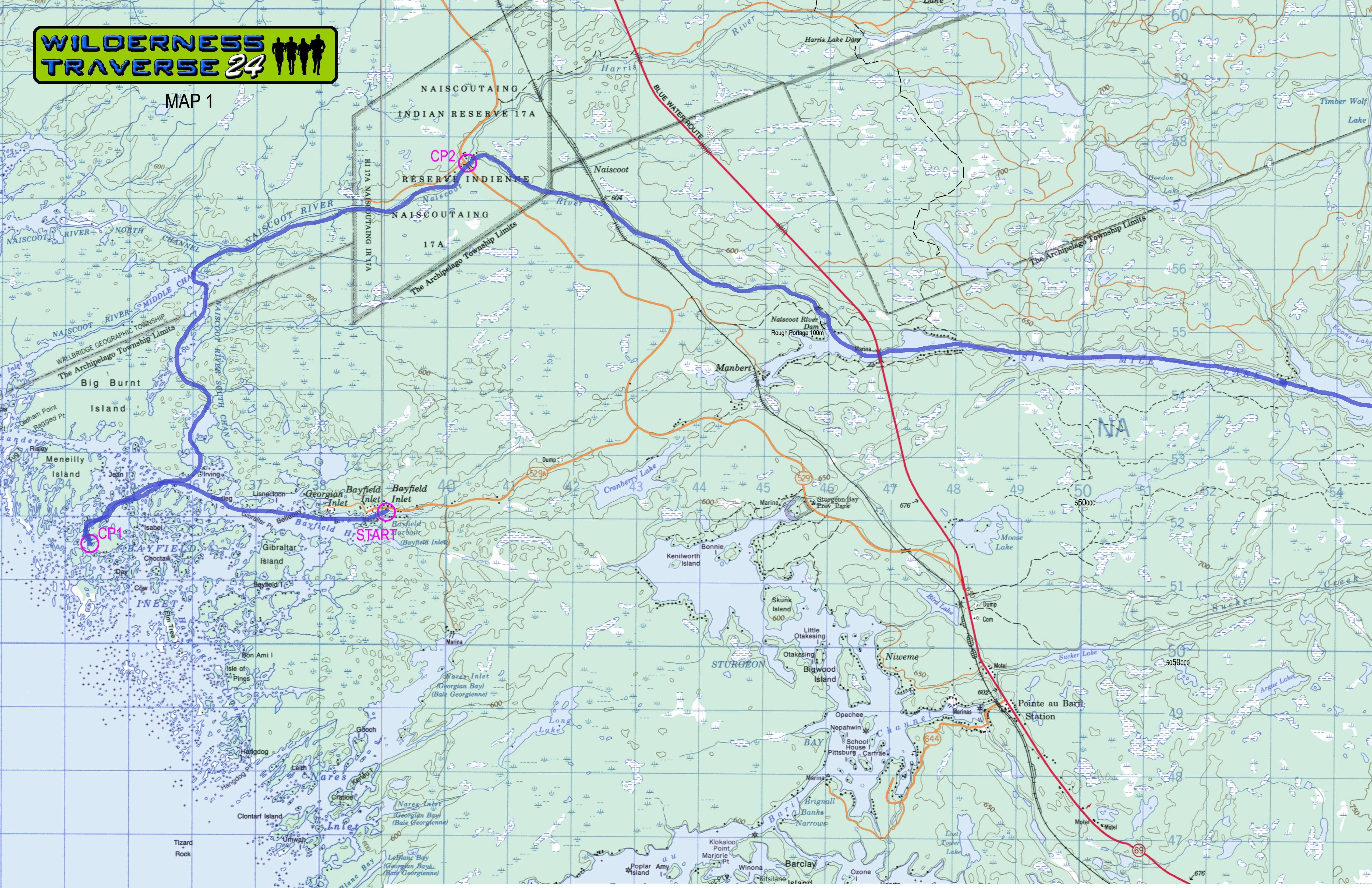
The first section of the first leg of the race was meant to put water navigation to the test, as it featured a canoe paddle amongst thousands of tiny islands to pick out a ‘needle in a haystack’ with a CP on one of the islands. You could either pick a direct route, or use a ‘handrail’ by sticking closer to the mainland and having visual cues of where to turn. We had chosen the ‘safe’ route as shown above (click to see full size), but unfortunately had our boats improperly balanced. Nat and I were in one boat, and James and Harper in the other. They were the stronger boat, so we had mismatched speeds. We arrived at CP1 to see many other teams had grabbed it and were on their way to the next CP already! Oh well, chasing from the back is easier, right? The full splits had us as 14th to arrive there!
We also delayed further at CP1 by shuffling the boats, now putting James and I in one boat, and Nat and Harper in the other. We all agreed it was ‘hammer time’, and set our goals on re-capturing the front of the race. With speed balanced out better, and fire in our paddles, we raced off. In short order, we had passed a number of teams, and were continuing to pull ahead. We then got a break further into the paddle when all the lead teams got tripped up in a ‘blind bay’ where the route back out to a river we wanted to follow was not obvious. We saw all the leaders, and even compared notes before we all set off en masse again.
We noted that Benoit (Team O-Store) and his crew opted to take a gamble and try for a portage rather than look for a tributary. However, we saw them just as we were actually starting the completely navigable stream, which in theory should help us. We traded paddle strokes with the other leaders, including the teams that had arrived at CP1 in 1st and 2nd. By the time we hit CP2, we were sitting in 4th overall, and held that placement until the first transition, where we were gearing up for the trek. All told, after the initial delays, we were pretty pumped with our position, especially knowing that our strength is in the trekking leg, which is what we were about to tackle. To buoy us even further, O-Store was still on the water, and we were leaving transition just as they were arriving. Their portage idea had hurt them, but they pushed hard to make up time.
Stage 2: Trekking
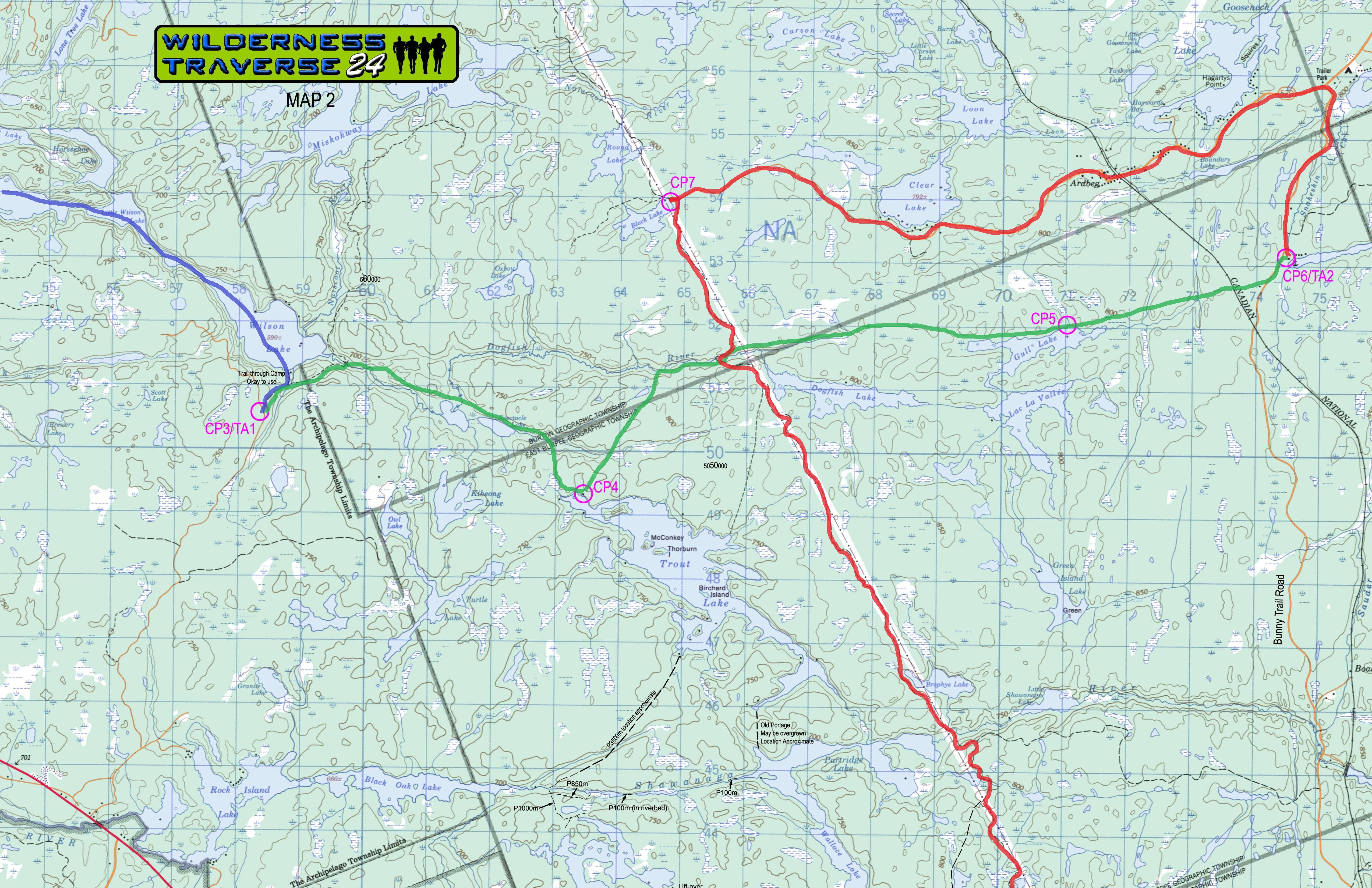 This section was where we knew we could pull ahead of many of the chasing teams by pulling off a solid trek. On the water, there is not much room to get ahead, as all teams are limited by hull speed on boats, as well as limited route options. With only 1 real portage, it had been just a straight up paddle. However, on the trek, there are many route options, and teams all have very different speeds when traversing real bush. We are fast on our feet, and have a top navigator to guide us. With over 20km of bushwhacking ahead of us, a LOT can happen.
We set to work on this section with a vengeance, with Harper leading the charge on a mission. Our first CP was a nice remote checkpoint where the staff had actually arrived by float plane on the lake! We crashed out of the woods to find out we were now sitting in 2nd place, and had arrived less than 10 minutes behind first place. We also learned that O-Store were now the team we were chasing! Yes, Benoit, the AR trekking legend, was working his magic once again and his team had completely overcome their earlier paddle snafu. As you’ll see, this is the theme that would define the rest of this race. O-Store in 1st, with use chasing hard, and a slightly longer gap behind us for 2 teams battling it out for 3rd.
The terrain had been [relatively] forgiving on the trek. Sure, we hit a number of swamps, but the bush itself was not super thick, which meant we were able to maintain a very good pace. At the end of the trek, Nathalie informed us this was the fastest she had ever moved through a bushwhack in a race. From CP4 to CP5, we veered NE to look for some features, deviating from the proposed ‘ideal route’ we saw later, which was a more easterly route. It resulted us in hitting a river, and following it for a while before catching on to an ATV trail that we’d revisit on the bike. Harper noted that we hit the river much further west than he’d hoped, but on arriving at CP5, and looking at the stats, I would say that didn’t hurt us, as we were holding steady at 2nd place, under 10 minutes behind O-Store. More notably, for the trek between CP4 and CP5, we were a mere 24 SECONDS slower than O-Store! That is an amazing stat for a race where you are literally crashing through the bush and everyone takes a slightly different route, hitting swamps, deadfall, etc.
The final leg of the trek was a straight bushwhack between CP5 and CP6/TA2. There were no good features or possible trails, so we just got to work on it. With more solid footwork, we emerged at the transition zone to see O-Store still there, with Benoit actually sitting down eating and resting. Imagine their surprise at seeing us so close! We had been only 2 minutes slower than them, and emerged still a mere 10 minutes behind them! They left in a hurry, but not fast enough, as we had a smell of blood! We pulled off a remarkably fast transition for trek to bike (fastest, at under 11 minutes), and left the peace of the transition zone now a mere 5.5 minutes behind the leaders.
Now, allow me to whine for just a moment about this type of racing. Transition zones, especially between two long legs, are a great chance to fuel up, change, and recharge. However, when you are racing at the level we were here, it is sheer panic and pandemonium. We are going through everything like a well-oiled machine, but you have to forego things like eating and sitting for a moment. O-Store had spent over 16 minutes in this transition, and the slower teams? They spent over 45 minutes there! Obviously, this is what you HAVE to do to be competitive, but inhaling two poptarts in 30 seconds is an impressive feat, but starting the bike with a mouth full of dry pastry and still putting gloves on can be a bit of a mental challenge! I seriously questioned whether I rather this kind of race or the more relaxed pace I had experienced at Untamed New England. Perhaps something in between?
Stage 3: The ‘Hydro Line’ Bike
Man oh man, what can I say about this leg of the race. It was by far the mentally most difficult, and technically pretty challenging as well. We were lucky, as we did 3/4s of this section of the race with daylight, and in dry conditions, but it was still a HELL of a slog! The beginning of this section was easy enough. About 12km of clear road riding. We formed a paceline, and just hammered. arriving at the next CP still about 9 minutes behind O-Store. Unfortunately, we were aware that the next, and super-long section of biking could be our weakness. As a team, we knew we’d be slower on the technical power line section than O-Store. We were also unsure how far our nearest competitors were, nor how fast they may be. All we could do was push hard, and maintain our pace.
We literally spent much of this leg glancing behind our shoulders, expecting to get passed at any point. Our nerves were also severely tested by a completely unforeseen foe. DEERFLIES! OMG. I have no words for what these bastards did to our spirits. Even Steely Harper completely lost his shit with them. Our speed was simply not fast enough to out-run them, and they kept flying directly into the vents on my helmet, eating chunks of my ‘head buffet’ as I battled the tricky riding, with both hands on the handlebars. All 4 of us were unanimous in our loathing. In a tough race, you do your best not to complain or be negative, but this was simply too much for us, and we basically were all whining like little babies, at times cursing at the top of our lungs at these buggers. Harper said he had NEVER experienced bugs this bad in ANY race he’d done (hint: he’s done LOTS, including in jungle climes).
Ok, rant over. The point is, the riding was tough, our going felt painfully slow, the trail was long, the terrain endlessly undulating, and our nerves shot from the bugs, AND spirits worried that we’d be passed at any moment. The hallelujah moment was at the next CP, where we were STILL in 2nd place, albeit trailing by almost 45 minutes :-(. This wasn’t the end of the bike though, and we were now continuing on in the dark, and the rain, for the final push to the next transition zone. Without the bugs though, this didn’t seem quite as miserable (yes, even in the rain). It was about another 12km of ATV trail riding.
On the closing kilometers of the bike, we passed by a slightly tired-looking team O-Store, who were starting the next trekking section. We knew the transition wasn’t too far ahead, and this lifted our spirits, knowing they were not super far ahead of us. They were also WALKING which had us surprised. Emerging at the TA, we discovered why. Apparently, Benoit was having some GI issues, and was periodically ill. Small blessing for us I suppose. By executing another blazing transition (over twice as fast as O-Store), we managed to leave that transition about 30 minutes behind O-Store, and not willing to give up the victory just yet.
Stage 4: Final Trek and Bike
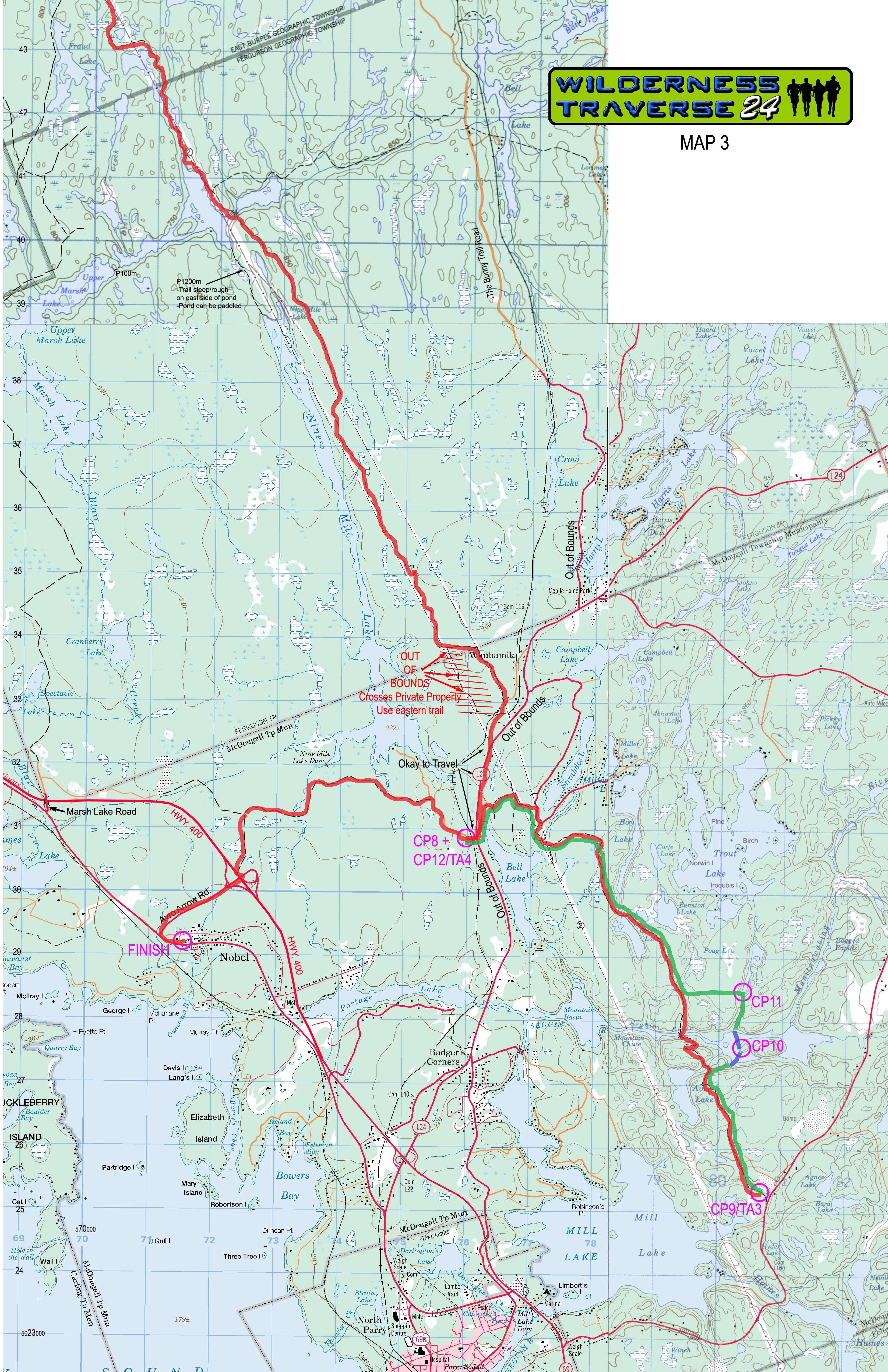
Well, this is it! The final push, and location of yet another ‘close call’ for Mr. ‘Zero percent body fat’ Meyer. We left that transition running hard. So hard that we momentarily set off on the wrong trail. D’Oh! We recovered quickly, but were annoyed at this trip-up. Our plan was to run the entire section where possible, in the hopes of closing the gap to O-Store, and ensuring we kept the 3rd place team safely at bay. Unfortunately, they did to us the exact same thing we had done to team O-Store. Namely, we crossed paths with them at nearly exactly the same place O-Store passed us. This meant we only had about 30 minutes on them too! Damn! That meant we had to keep pushing hard, in spite of starting to feel the effects of a long day racing at 100% output.
At this point, it was raining, but nothing too hard yet, so the terrain wasn’t too bad. For this section, we had about a 10-12k trek to pull off before the final bike leg. As part of the trek, we also had the ‘option’ to swim to a couple checkpoints rather than taking a long trek around. Of course, it wasn’t really an ‘option’ for us, as we knew we had to do this to keep the pressure on. Armed with that knowledge, I had put a dry shirt and rain paints and raincoat in a dry bag in my pack with the intention of changing directly after our swim.
We made good time on the lead-up to the swim, and wasted very little time in ‘taking the plunge’. Our progress was only slightly nerve-wracking in the fact that we were tackling this in the depths of the darkness. Although it was supposed to be a full moon, the rain and clouds meant no visibility. Luckily, the volunteers at one CP had lit a fire, so we essentially had a beacon for the first swim. The distance was likely around 300m. Had we had daylight, I suspect we could have chosen a spot just a bit further that would have made that 200m. Regardless, off we went, swimming out little hearts out.
Unfortunately for me, I started cramping about halfway into the swim. These were leg cramps that I couldn’t get massaged out. I have to be honest, this was a bit frightening, as we had no flotation, and not a lot of chance for any sort of rescue, so I knew I had to suck it up. Luckily, my years of swim lessons (and lifesaving lessons!) kept me relatively calm, and I just focused on using my arms only. It made for slower progress, but I got there. Once at the CP, I hopped out to take a minute to attempt to massage out the cramps, before we hopped back for the next swim.
Harper estimated this swim at 100m, but in reality, it was as long as the first, and I guess 300m. Looking at the maps, it was painfully clear that we *could* have cut that to between 50 and 100m by going a little way around the point, but in the darkness, we opted to just head straight towards our landmark, which was a stream on the other side. By the time we hit the far shore, I wasn’t the only one getting a big cold, and we took the time to ensure we’d stay warm for the next bit. For me, that meant stripping off a layer on top and bottom, and swapping out for a dry shirt and putting on my rain gear. I instantly felt better. Well, except for my legs, which were left rather sore from the cramping. I wolfed down as much food as I could while everyone else finished getting set. Then off we went, back in pursuit.
This bit wasn’t too bad, and we managed to hit a good stream that took us basically straight to the final trekking CP. Elated with that, we bushwhacked quickly back to the ATV trail which we’d follow back to the road. Guess what we did once there? Yup, RUN. Ugh. I was feeling pretty beat, but didn’t dare say anything, and just joined in. Within a very short time, I was then overheating with the extra layers, AND had to have a nature break, but had nary time to deal with either. Eventually, James helped by carrying my pack while I peeled off my jacket and pants WHILE RUNNING. It was tricky, but allowed us to not lose much time. For the nature break, try as I might, I was unable to do the ‘running pee’, and eventually pulled off, did my business, then had to run twice as fast to catch back up. Double ugh. But, these are the things you HAVE to do to win. We were also paranoid that team Epitact from France would emerge behind us at any time.
This effort did net us the fastest split on the final run from that CP to the transition, and ready to mount up on our bikes for the final push. On arrival at that TA, we learned that O-Store was still exactly 30 minutes ahead of us. D’oh! Apparently they found their mojo again. The final leg was a biking leg, and was supposed to only take about an hour, which meant catching them would likely not be feasible. Despite that, we left quickly, in order to keep a gap on 3rd place. At that point, we had no way of knowing they’d eventually fall over 1.5 hours behind us at that transition! Soggy and tired, we mounted our bikes, and pedaled off into the darkness, aware there was one final ATV section, before grabbing roads to the finish.
This final ATV section is where something interesting happened. THE SKIES OPENED UP! And I mean sheet rain. It was the heaviest rain we’d ever raced through in Ontario, and it lasted. Not just 5 minutes, but for HOURS! Knowing O-Store was probably out of the ATV section by then, we were totally sunk. We had to navigate the final bits of the race in rivers that were forming on the trail. Eventually all we could do was laugh. We knew everyone else was stuck in the same shit, so it would be a great equalizer, and guarantee our placing basically. Luckily, it wasn’t too cold.
Emerging at the 400, all we had to do was jump on the access road to town, and ride the big hill back to the finish area. Our time on this section was the worst of the 4 teams that eventually actually did it (only the top 4 teams did the full course including this ATV section, the rest of the ‘full course’ teams were allowed to go by roads the whole final section. We lost another 15 minutes on O-Store, meaning we finished off 45 minutes behind them at the finish. Despite this, they all told us this was the hardest they had to race to ensure their victory in this race in their last few years, which made me feel pretty good. They were nice enough to still be up to greet us. Apparently they had been quite surprised to see us in the transition zones where they did. We gave them a good run for their money (both figuratively and literally, given the $1500 cash prize on offer!).
When all was said and done, we’d raced nearly 21 hours non-stop at full throttle, and had a great result to show for it. All our gear and nutrition worked perfectly in this race, so big shout out to all our various sponsors and supporters (Xact Nutrition, 2XU, North Face, Nuun, Milk2Go Sport, and Osprey Packs popping into mind right away). 3rd place was another 1.5 hours behind us, and 4th place another 1.5 hours behind them! Amazing race. Undoubtedly, much of this likely had to do with the extreme rain that had taken over the course. As we went to sleep for a couple hours, it was insane how heavy the rain was falling down.]
Once we were back up, we dealt with gear, had a first breakfast, then a BBQ lunch, and finally the awards ceremony, and time to catch up with our fellow competitors. All agreed that this was yet another epic Wilderness Traverse for the books. Bob always puts on a great race, and it seems every year, the weather also plays a starring role. We’re already looking forward to returning next year for another run at Bob the Beaver (the winner’s trophy). But till that time, there’s still lots more racing. For me, next up is the Bruce Peninsula Multisport Race, which I’m really looking forward to. For that one, I’ll also be filming, so keep your eyes open for that report! Till then, hope everyone is having as much fun this summer as I am!
Steve
Monday, 23 June 2014
Untamed New England Expedition race-10th overall
Back at another Untamed with James (Relentless) and John (threeputt) with new addition to the team Natalie (Frenchie). Check in, maps, all went fast with minimal checks, pre-plotted maps. A++ for Grant and team making this part of the race lead-up pain free.
Race start was using some iffy maps for a prologue rogaine foot section. Kept a good pace with the lead teams and got off around 7th onto the boats. With Nat being a strong paddler we were able to get ahead of a few teams catching up to Columbia tied for 3rd into the run to Little Kineo. This was key as getting to the ropes was crucial since the backlog kept teams waiting hours. Even though we were fourth team in, we still waited near 20mins as only a few ropes were being used. Not sure why RD’s still put these things in races?!?!?
Of the rappel we navigated to the closest road and ran back down to the canoes, paddled to Kineo Island obtaining two more CP’s, the last of which was a little tricky. Raidlight passed us during the run but then missed the last CP, asking us if we found it after we already had nabbed it… ughhh… uncomfortable… I played the ‘I don’t speak French’ card but unfortunately on this team that card doesn’t play well since Nat had already spoken French with them at the ropes and we eventually told them we found it back where it was. They shouldn’t have asked us but what can you do when asked…
Back in the boats we paddled to the first TA which we reached in good time and were given some nice chili by Good To-Go sponsors. Transition out and onto the bikes where eventually Sweco catches and passes us through the night. The nav goes well but our pace isn’t very fast; perhaps we are still recovering from hammering the run/paddle for the first 8 hours. We hit the bike bushwhack and aren’t one of the fortunate ones who find a trail; we just whack for an hour or some; pretty miserable going.
Eventually we pop out to see Clinique has also passed us as they found a good trail. We continue to move on the bike, albeit fairly slow and by the time we get near the Orienteering section at Gorman Chairback lodge John’s feeling rough. We re-strategize our order slightly so John can get some rest while Nat does the short/hard, James the long/easy, me the long/hard and pass over to John for short/easy at which point he’s feeling tip top again. We try to get some sleep but no one gets anything more than a few mins – we are still only 24 hours into the race. Pancakes and Kool-Aid are awesome. After we all finish our o-sections we make short order of the wood stacking and are off on the ‘monster’ bike again.
We continue to ride along without any nav issues and make it to the (dreaded) Abenaki Lost World. We inflate our packrafts and immediately it’s apparent that John and I have not practiced our layout in our newly purchased $800US Alpacka. While we’re stumbling along the shore, we’re passed by Clinique and MadAthlete teams who blaze along with their $1500 Alpackas that have about twice the hull speed of ours. Eventually we settle into our uncomfortable positions while trying to manage the high winds on Third Roach Pond. The winds are brutal and we have to paddle straight into them at maybe 2km/hr. It’s painfully slow and sucks. We deflate and bushwhack after looking with no avail for the stream connecting Second and Third Roach Ponds. Back on water at Second Roach Pond and even more headwind. By the time we hit the CP on the lake Nat is near hypothermic and we make the decision to abandon the packrafts as we don’t feel safe in the high winds, cold water and no signs of a safety boat. We make for the south shore where we deflate and pack up while hiking the trail around the lake. It’s nice to be warm and hiking again but the time it takes transition isn’t pretty and we soon realize we probably should have just sucked it up and paddled the lake. We lose a lot of time here I suspect and we even flub the peninsula CP on Second Roach Pond as I assumed it was on the very end instead of the middle. O-store.ca passes us here and told us they just decided to run most of it vs packraft.
We trek on and arrive at the final CP before the First Roach Pond crossing. It’s night and the wind is back up, it feels extremely unsafe again with no safety boats and us crashing into high waves. We eventually make the crossing and are happy to be done with the packrafting (for now).
After taking a little while to change and eat we head out to start the big trek. It’s night number two so we decide we should take our first rest of the race. The temperature is cold, we can see our breath, feels like 5C or so. We cram into the ‘cozy’ tent, set the alarm for 1:45 time of sleep and roll around cold and uncomfortable. I think we all maybe got 20 minutes? Maybe an hour? Who knows but it wasn’t quality sleep.
We are now on the big trek and hike up the first mountain taking all roads/trails to play it safe and manage the first one without any issues. Had a terrible route to the next CP taking the ridegeline instead of descending to the parallel trail, I have no idea why I marked that; stupid. It’s now daylight of Day 3 and we take the ridgeline to the trail and make our way to the second mountain top which ends up OK. One final mountain and we’re done, right? We are thinking about our free sleep at the rafting already, however, the last trek CP is ABSOLUTE SHIT, the worst I’ve experienced. About 4? 5? 6? Hours of painfully slow whacking through tightly packed spruce trees, ripping away at our skin, packs and clothing. We lose an hour trying to make sense of a flagged trail near the saddle near the summit praying to the Abenaki gods that this trail will take us to our CP but it just meanders around. When we finally are near the summit we run into a cameraman who was about to turn around to his car, frustrated and beaten by the bushwhack but he follows us up to the mountain CP (see us on the Untamed Youtube at 5mins into the video: https://www.youtube.com/watch?v=m-yWb0lrLYM&list=U...) with John highlighting how lovely the last CP was. Like most teams we were without water for all of this section from the last mountain (maybe 8 hours).
Thankfully there was a trail leading down out of the CP (it was glorious not to have to bushwhack down) and we slowly made our way back to the TA. We moved slow on this easy (but buggy) road trek, a section we probably should have ran but were feeling pretty beat down by the trek and very dehydrated and hungry. My feet were starting to blister as per usual even though I felt like I took good care of them. On the plus side we actually didn’t think many other teams would have fought that hard for the last CP; alas we underestimated our AR colleagues and learned we just maintained our position near 10th spot. Was demoralizing to hear how fast Benoit on o-store.ca did the trek in, less than half our time although we did sleep.
When we got to the TA we learned the paddle was cancelled. Even though it seemed to be our strongest discipline I was happy to hear we’d be biking to the next CP. My chafed butt wasn’t enjoying though. Perhaps I should mtn bike a few times before doing an expedition race to get my ‘body’ adapted... Regardless it was much quicker and we arrived at the urban o-section in Greenville quickly. We did a run/walk for most of the section and were able to order a delicious meat-lovers pizza just before the shop closed. We washed it down with coke and ice-cream sandwiches are were off again to start the ascent up Moose Mountain range. We took a 5 minute nap on good trail then found a nice buggy marsh to do another 20-min nap; not very well executed. The climb up went well for us and eventually we made it down the other side to the ski area where the long descent was painful on our sore feet.
At the ski lodge TA we plotted a few more CPs. I knew one these would not be as easy as it seemed because the last Untamed we did in 2010 Grant threw a knuckleball in for the last bike where the trails weren’t on the map or were not matching. After our best nap of the race - 20 mins on the side of the road in the glorious hot sun - we got the first CP on Indian Pond with ease so I figured the next one would be the tricky one, which it was. However, we played it relatively safe and didn’t try to force any routes, stuck to our bearings and make sure I knew exactly where we were on the map. It proved successful as we nailed the CP with relative ease and finally picked up our bike speed pacelining to the rafting put-in.
The rafting was fun, a lot of big water and eventually some lesser class rapids which we guided on our own. At The Forks we transitioned to the final trek/packraft section. Like many others have reported, this section was a slog; the bugs were bad and the little trek just seemed to go on and on. Eventually we made it to the area where the CP was, descended down to the river and inflated our packrafts. Earlier we made the decision John and I would packraft on our own because fitting the both of us in the Alpacka just didn’t work well so John braved his $80 Canadian Tire Sevylor while I took the pimped Alpacka. Nat and James stayed in their NRS. We pushed off and were thrown into the rapids immediately. It was a white knuckle ride and we were trying to navigate while staying afloat. John was a rockstar in the Sevylor where he had to pull over after each rapid and dump his boat but was having a lot of fun. Meanwhile on the river it was carnage with hypothermic teams littered along the shoreline. We pulled over with MadAthlete to help ActiveSteve get warm at one point but had to leave (him with his able team) as fear of our teammates getting hypothermic was also a concern. As for the checkpoints - for some reason the CPs were hidden in the forest; personally not sure why as this was a packraft section and along the water would have been more appropriate. Each CP took several times getting out checking, etc as there wasn’t any distinguishable features to go off on the map.
There was a portage featured along the map which we planned to take but no sign and apparently we went down the rapids of concern. No safety guides along the river either pointing out appropriate lines or helping stranded packrafters. Maybe I’m not as comfortable in whitewater as many but it just didn’t seem very safe and I was very happy to get out luckily just before sunset. I couldn’t believe while taking out I saw teams trekking up to the packraft put-in – at night!!?!? We took out a few kms from the take-out as we hoped to get warm running it in to the TA, however, I just got eaten alive by bugs by the side of the road while trying to change into warm clothes and fend off yet another bout of shivering and hyperthermia in the race.
The last TA featured us biking up to a mountain top CP before going to the finish line. I set up a conservative route using a ‘black-line’ which at this point of the race could have been a trail, doubletrack or road; it didn’t seem consistent. But this one had a road name so I thought it was a safe bet for us. It wasn’t too bad although I think it was slower than the obvious recommended route on a brown line but I didn’t want to take any chances. Once at the final CP we descended down the brown trail line directly to the finish line which thankfully went the way marked on the map. We made it after 4 long tough days!
It was just before midnight, I was praying the kitchen was still open – it was – apparently all night!!! BEST FINISH LINE SPOT EVER. We immediately ordered chili nachos, 4 lbs of wings and burger/fries for everyone while drinking awesome free beer and chatting with our fellow competitors. Eventually our eyes wouldn’t stay open any longer and we crashed to our cabin.
Final results have us marked as 10th which is fair given the level of competition. We could have done a bit better had we managed the packrafting/big trek a bit better but also could have fared worse had we made any big nav mistakes. The team worked well together although the dynamic and usual strengths of our team changed; racing with a ‘couple’ (Nat and James) and not being as fast on our feet as usual (but being better paddlers was nice).
Next up is Wilderness Traverse - can’t wait for such a short race!
Harper
Race start was using some iffy maps for a prologue rogaine foot section. Kept a good pace with the lead teams and got off around 7th onto the boats. With Nat being a strong paddler we were able to get ahead of a few teams catching up to Columbia tied for 3rd into the run to Little Kineo. This was key as getting to the ropes was crucial since the backlog kept teams waiting hours. Even though we were fourth team in, we still waited near 20mins as only a few ropes were being used. Not sure why RD’s still put these things in races?!?!?
Of the rappel we navigated to the closest road and ran back down to the canoes, paddled to Kineo Island obtaining two more CP’s, the last of which was a little tricky. Raidlight passed us during the run but then missed the last CP, asking us if we found it after we already had nabbed it… ughhh… uncomfortable… I played the ‘I don’t speak French’ card but unfortunately on this team that card doesn’t play well since Nat had already spoken French with them at the ropes and we eventually told them we found it back where it was. They shouldn’t have asked us but what can you do when asked…
Back in the boats we paddled to the first TA which we reached in good time and were given some nice chili by Good To-Go sponsors. Transition out and onto the bikes where eventually Sweco catches and passes us through the night. The nav goes well but our pace isn’t very fast; perhaps we are still recovering from hammering the run/paddle for the first 8 hours. We hit the bike bushwhack and aren’t one of the fortunate ones who find a trail; we just whack for an hour or some; pretty miserable going.
Eventually we pop out to see Clinique has also passed us as they found a good trail. We continue to move on the bike, albeit fairly slow and by the time we get near the Orienteering section at Gorman Chairback lodge John’s feeling rough. We re-strategize our order slightly so John can get some rest while Nat does the short/hard, James the long/easy, me the long/hard and pass over to John for short/easy at which point he’s feeling tip top again. We try to get some sleep but no one gets anything more than a few mins – we are still only 24 hours into the race. Pancakes and Kool-Aid are awesome. After we all finish our o-sections we make short order of the wood stacking and are off on the ‘monster’ bike again.
We continue to ride along without any nav issues and make it to the (dreaded) Abenaki Lost World. We inflate our packrafts and immediately it’s apparent that John and I have not practiced our layout in our newly purchased $800US Alpacka. While we’re stumbling along the shore, we’re passed by Clinique and MadAthlete teams who blaze along with their $1500 Alpackas that have about twice the hull speed of ours. Eventually we settle into our uncomfortable positions while trying to manage the high winds on Third Roach Pond. The winds are brutal and we have to paddle straight into them at maybe 2km/hr. It’s painfully slow and sucks. We deflate and bushwhack after looking with no avail for the stream connecting Second and Third Roach Ponds. Back on water at Second Roach Pond and even more headwind. By the time we hit the CP on the lake Nat is near hypothermic and we make the decision to abandon the packrafts as we don’t feel safe in the high winds, cold water and no signs of a safety boat. We make for the south shore where we deflate and pack up while hiking the trail around the lake. It’s nice to be warm and hiking again but the time it takes transition isn’t pretty and we soon realize we probably should have just sucked it up and paddled the lake. We lose a lot of time here I suspect and we even flub the peninsula CP on Second Roach Pond as I assumed it was on the very end instead of the middle. O-store.ca passes us here and told us they just decided to run most of it vs packraft.
We trek on and arrive at the final CP before the First Roach Pond crossing. It’s night and the wind is back up, it feels extremely unsafe again with no safety boats and us crashing into high waves. We eventually make the crossing and are happy to be done with the packrafting (for now).
After taking a little while to change and eat we head out to start the big trek. It’s night number two so we decide we should take our first rest of the race. The temperature is cold, we can see our breath, feels like 5C or so. We cram into the ‘cozy’ tent, set the alarm for 1:45 time of sleep and roll around cold and uncomfortable. I think we all maybe got 20 minutes? Maybe an hour? Who knows but it wasn’t quality sleep.
We are now on the big trek and hike up the first mountain taking all roads/trails to play it safe and manage the first one without any issues. Had a terrible route to the next CP taking the ridegeline instead of descending to the parallel trail, I have no idea why I marked that; stupid. It’s now daylight of Day 3 and we take the ridgeline to the trail and make our way to the second mountain top which ends up OK. One final mountain and we’re done, right? We are thinking about our free sleep at the rafting already, however, the last trek CP is ABSOLUTE SHIT, the worst I’ve experienced. About 4? 5? 6? Hours of painfully slow whacking through tightly packed spruce trees, ripping away at our skin, packs and clothing. We lose an hour trying to make sense of a flagged trail near the saddle near the summit praying to the Abenaki gods that this trail will take us to our CP but it just meanders around. When we finally are near the summit we run into a cameraman who was about to turn around to his car, frustrated and beaten by the bushwhack but he follows us up to the mountain CP (see us on the Untamed Youtube at 5mins into the video: https://www.youtube.com/watch?v=m-yWb0lrLYM&list=U...) with John highlighting how lovely the last CP was. Like most teams we were without water for all of this section from the last mountain (maybe 8 hours).
Thankfully there was a trail leading down out of the CP (it was glorious not to have to bushwhack down) and we slowly made our way back to the TA. We moved slow on this easy (but buggy) road trek, a section we probably should have ran but were feeling pretty beat down by the trek and very dehydrated and hungry. My feet were starting to blister as per usual even though I felt like I took good care of them. On the plus side we actually didn’t think many other teams would have fought that hard for the last CP; alas we underestimated our AR colleagues and learned we just maintained our position near 10th spot. Was demoralizing to hear how fast Benoit on o-store.ca did the trek in, less than half our time although we did sleep.
When we got to the TA we learned the paddle was cancelled. Even though it seemed to be our strongest discipline I was happy to hear we’d be biking to the next CP. My chafed butt wasn’t enjoying though. Perhaps I should mtn bike a few times before doing an expedition race to get my ‘body’ adapted... Regardless it was much quicker and we arrived at the urban o-section in Greenville quickly. We did a run/walk for most of the section and were able to order a delicious meat-lovers pizza just before the shop closed. We washed it down with coke and ice-cream sandwiches are were off again to start the ascent up Moose Mountain range. We took a 5 minute nap on good trail then found a nice buggy marsh to do another 20-min nap; not very well executed. The climb up went well for us and eventually we made it down the other side to the ski area where the long descent was painful on our sore feet.
At the ski lodge TA we plotted a few more CPs. I knew one these would not be as easy as it seemed because the last Untamed we did in 2010 Grant threw a knuckleball in for the last bike where the trails weren’t on the map or were not matching. After our best nap of the race - 20 mins on the side of the road in the glorious hot sun - we got the first CP on Indian Pond with ease so I figured the next one would be the tricky one, which it was. However, we played it relatively safe and didn’t try to force any routes, stuck to our bearings and make sure I knew exactly where we were on the map. It proved successful as we nailed the CP with relative ease and finally picked up our bike speed pacelining to the rafting put-in.
The rafting was fun, a lot of big water and eventually some lesser class rapids which we guided on our own. At The Forks we transitioned to the final trek/packraft section. Like many others have reported, this section was a slog; the bugs were bad and the little trek just seemed to go on and on. Eventually we made it to the area where the CP was, descended down to the river and inflated our packrafts. Earlier we made the decision John and I would packraft on our own because fitting the both of us in the Alpacka just didn’t work well so John braved his $80 Canadian Tire Sevylor while I took the pimped Alpacka. Nat and James stayed in their NRS. We pushed off and were thrown into the rapids immediately. It was a white knuckle ride and we were trying to navigate while staying afloat. John was a rockstar in the Sevylor where he had to pull over after each rapid and dump his boat but was having a lot of fun. Meanwhile on the river it was carnage with hypothermic teams littered along the shoreline. We pulled over with MadAthlete to help ActiveSteve get warm at one point but had to leave (him with his able team) as fear of our teammates getting hypothermic was also a concern. As for the checkpoints - for some reason the CPs were hidden in the forest; personally not sure why as this was a packraft section and along the water would have been more appropriate. Each CP took several times getting out checking, etc as there wasn’t any distinguishable features to go off on the map.
There was a portage featured along the map which we planned to take but no sign and apparently we went down the rapids of concern. No safety guides along the river either pointing out appropriate lines or helping stranded packrafters. Maybe I’m not as comfortable in whitewater as many but it just didn’t seem very safe and I was very happy to get out luckily just before sunset. I couldn’t believe while taking out I saw teams trekking up to the packraft put-in – at night!!?!? We took out a few kms from the take-out as we hoped to get warm running it in to the TA, however, I just got eaten alive by bugs by the side of the road while trying to change into warm clothes and fend off yet another bout of shivering and hyperthermia in the race.
The last TA featured us biking up to a mountain top CP before going to the finish line. I set up a conservative route using a ‘black-line’ which at this point of the race could have been a trail, doubletrack or road; it didn’t seem consistent. But this one had a road name so I thought it was a safe bet for us. It wasn’t too bad although I think it was slower than the obvious recommended route on a brown line but I didn’t want to take any chances. Once at the final CP we descended down the brown trail line directly to the finish line which thankfully went the way marked on the map. We made it after 4 long tough days!
It was just before midnight, I was praying the kitchen was still open – it was – apparently all night!!! BEST FINISH LINE SPOT EVER. We immediately ordered chili nachos, 4 lbs of wings and burger/fries for everyone while drinking awesome free beer and chatting with our fellow competitors. Eventually our eyes wouldn’t stay open any longer and we crashed to our cabin.
Final results have us marked as 10th which is fair given the level of competition. We could have done a bit better had we managed the packrafting/big trek a bit better but also could have fared worse had we made any big nav mistakes. The team worked well together although the dynamic and usual strengths of our team changed; racing with a ‘couple’ (Nat and James) and not being as fast on our feet as usual (but being better paddlers was nice).
Next up is Wilderness Traverse - can’t wait for such a short race!
Harper
Tuesday, 27 May 2014
Steve Loses Passport, Snags 3rd in Solo at Raid Pulse
If there is one thing that can be said for adventure racing, its that you never stop learning, and you never give up. Actually, I guess that's two things! Well, at any rate, as mentioned in James' race report, I was also at the Raid Pulse race going solo. Unofficially, racing AGAINST James and Nat :-). Of course, I was pretty sure that I would get my butt kicked by James. He has been on an absolute winning streak. Congrats! However, that didn't stop me from trying!
I was not only racing, but also getting some footage to put together a video race review, which you can see below. Sadly for me, I lost my passport in the big trekking section (it was [lossely] tied around my neck). Spent about 15 minutes backtracking, which in an 8 hour race is an eternity. This lead (unknown to me) to a drop of several rankings in the overall standings, but I did maintain my 3rd place solo, clearing almost the entire course (only missed the final 2 advanced CPs, which only 3 teams nabbed). To read my whole blog post just head over to my site.
As for the video, check it out here:
Subscribe to:
Posts (Atom)