Showing posts with label 24h adventure race. Show all posts

Wednesday, 16 August 2017

ARWC 2017 Cowboy tough- 23rd

They say one of the hardest things to do in adventure racing is to get 4 people to the start line of a race. This race would prove that statement true. After months of searching, finally securing a 3rd team mate, almost securing a 4th team mate, losing the 3rd team mate, finding a replacement 3rd team mate (Chad Spence), and sending out countless emails to almost all of the Canadian and international racers we know (and many we don’t know personally), Nathalie and I (James) found ourselves literally hours away from cancelling our trip to the Adventure Racing World Championships two weeks before the race. But with a little luck, we were finally able to secure a 4th team mate – Ben Brewer - a newcomer to expedition racing, but an experienced navigator and strong racer at shorter distances.
This was not only a new team configuration, each of us was walking into the race with our own challenges and unknowns: Ben was racing his first race beyond 36 hours, Chad was facing his longest expedition race to date and the challenge of navigating at a World Championship, Nathalie was in the best shape of her life and ready to challenge herself to be a leader in pushing the team forward on the course, and I was dealing with a knee injury sustained in a mountain bike crash 5 weeks before the race. So we knew going in that the race ahead of us would really be a test for each of us as individuals, and as a team.
Our race preparations went relatively smoothly, despite the usual difficulties of gear bin logistics and the opening ceremony went well with lots of little fun challenges.


 But we got everything organized relatively quickly and had the evening before the race start to relax, unwind, and get to know each other a little better. We got the maps as we stepped onto our busses at 5:30am on August 10th for a 5 hour bus ride to start of the race in Jackson Hole, WY. Once arrived, it wasn’t long until the race was underway.


We started with an orienteering course prologue on the side of the ski hill, followed by a 12km run (Leg 1) on a paved trail. As usual, our team agreed that we would not start out too fast and burn ourselves out in the first legs of the race… and as usual we completely ignored this agreement and ran like idiots trying to keep up with all the other teams in the mid-day heat! 


We arrived at the transition to pack rafts about mid-pack, ready to start Leg 3 of the race. This was a nice, rather uneventful paddle down a moving river as we prepared ourselves for the major hiking and biking that lay ahead.
Leg 4 was our first step into the long, challenging middle portion of the race course. This 62km hiking leg featured over 10,000ft of climbing, with no checkpoints. While this leg was mainly on trails, one concern was the lack of access to water on the trail and the possible need to come down off the ridge early to gain access to water sources below. While we were not as quick as we would have liked to be, we managed to maintain a steady pace and manage our water supply enough to avoid having to come down early from the ridge. The trek offered many stunning views as we trekked on into the first night.  


Leg 5 featured our first bike section – a 133km ride mainly on roads. The challenge here was to move as quickly as possible on the good road surfaces and keep a hard, steady pace moving forward. Early in this section we tried to work with a few teams to move more quickly together, but had to eventually slow our pace down to avoid burning anyone out.
Leg 6 of the race was an even longer trek than the previous one with about two thirds of the elevation. This trek generally followed the continental divide – an imaginary line through the mountains that separates East and West flowing rivers. For the most part there was an actual trail along the continental divide, but at points it disappeared and made for some challenging navigation. One of the most difficult off-trail navigation sections was on this leg as well and consisted of a hilly area littered with fallen trees, which made travel very slow and difficult. Most teams struggled here, including us, losing about 5 hours looking for CP9.
At this point, it’s worth mentioning that our sleep strategy was fairly poorly executed in this race. We opted to not sleep on the first night and only sleep 45 minutes on the second night. The sleep details after day 2 are pretty blurry to all of us, with many random stops for a short rest and too much wandering along while mostly asleep. This is an area where we certainly needed to be more proactive, as the lack of sleep really caught up to us late in the race.
After completing the two major treks in the race, it was time to turn our focus to the massive bike leg(s) ahead – a 58km ride followed by a mind-boggling 264km more of biking, with a short trek and ropes/caving section in between the two. Leg 7 had a bunch of gravel road and paved roads, but ended with a spectacular cliff-edge trail that we rode in the middle of the night, followed be an excellent single track section to get us down the mountain. We quickly got transitioned and off to the caving section and then up to the ropes. There was about an hour backup at the ropes so we were able to get a little bit of rest here. After the rappel in the dark, we headed back to the TA and opted for a little bit of sleep before heading off on the big bike ride. 


The 264km bike leg was all about covering terrain to get ourselves all the way back to the Casper area and near the finish line. As we were progressing on the mammoth bike leg a pretty big storm was brewing just behind us which kept us motivated to move forward.


We did most of the ride in the daytime and then had another quick sleep the following night before heading into a sandy section of trail (“The Dunes”). We had heard a few teams pass us while we slept so when we woke up, we pushed to catch back up to them.  We traveled with them for a while until they appeared to head in a direction we weren’t sure we wanted to go to get to the next checkpoint. We spend the next couple hours trying to figure out where we were at on the confusing network of trails, only to discover that earlier we had passed right by the checkpoint we were looking for. So we had to backtrack quite a ways to find the CP. We then tried unsuccessfully a few times to find a way out of the area that was less sandy, which cost us even more time.
We finally got ourselves to the back-to-back packraft legs of the race. The first of these (Leg 10) was a flat water paddle on a reservoir after a 10km hike from the TA. This was a rather uneventful paddle, until we set out to cross the dam to begin the whitewater portion of the paddling. Just as we were crossing the dam, a storm blew in very quickly. We were lucky enough to be able to use the buildings at the dam to shelter ourselves from the strong winds and pounding rain. We waited out the storm for about 20 minutes and then headed down to the bottom of the dam as soon as we felt it was safe. We put our packrafts in the water and paddled another 15 minutes before a second, even larger storm blew in. This time we didn’t have the luxury of any buildings nearby to protect ourselves, so we pulled over to the shore and created a lean-to shelter with our 2 rafts to protect ourselves from the storm. We all huddled under our makeshift shelter while observing the massive thunder, lightning, high winds, and heavy rain all around us. The tension was relieved by the sound of Chad frequently trying to slurp up the rainwater that was leaking overhead directly into the hood of his zipped up rain jacket and right past his mouth.
Once the storm passed, we finally got back onto the river and into the canyon portion of the rapids. This would be the most challenging whitewater section of the race. We were greeted at the biggest rapid by a rescue person (Brad – a fellow Canadian volunteering at the race) who informed us of our options: River right was less of a drop but required a tight turn mid-way through, while river left had a steep drop and water pushing up against a rock wall at the bottom of the rapid. We all agreed that river right would be the best/safest way to go. Chad and Nat took the lead and headed down the rapid, just out of sight from where Ben and I waited. Once we got the signal from Brad that they were through, I steered our packraft toward the rapid but could not see the river right option that Brad had described… So down the steep left side we went, luckily without incident.  The remainder of the rapids seemed much more tame and we thought we were relatively home free for the whitewater section. However as Chad and Nat passed through what seemed like an innocuous rapid, their boat was punctured and sank very quickly. We could hear Nat screaming something (which we found out soon after was that her paddle was floating away) as she and Chad tried to gather themselves and their gear in the rapids. We got pulled into the flow as well and as we approached, Chad warned us about a sharp rock in the rapid that had popped their boat. I identified what looked like the sharp rock and proceeded to work around it (and them) to head off to retrieve Nat’s paddle. I quickly found out that the rock I identified was not the right one! So there we were, 4 people, 2 punctured boats, gear floating away everywhere, and everyone scrambling to minimize the carnage. (Sidenote – we discovered later that this sharp rock had been identified by the organizers in our race notes, but because of the heavy rains from the storms just before we got there, this rock was now underwater when we got there and appeared to just be another smooth boulder in the rapid). We managed to get everyone to shore and gather our wits as we figured out what to do. Just then we spotted a photographer just below the next rapid on the shoreline and what appeared to be a reasonable climb out of the canyon. So we each grabbed a handful of gear and swam the next rapid then quickly got to the shore and worked our way up the steep canyon wall and out to the road above. This took a considerable amount of time and during the climb Chad slipped while trying to move some of the heavier gear up the canyon wall and fell quite painfully on his hip and knee.
Once we got to the road, we were soon met by a medic and a race referee (they must have been tracking us!). This was very fortunate for us because with the race referee present, we were able to get minimal help from the medic without breaking any rules about assistance, and the referee was able to inform us of our options for moving forward in order to stay ranked in the race. We were able to work out 2 possible options: borrow packrafts from a team who had finished the paddling section but were still in the race, or take a time penalty for taking roads instead of paddling a particular section that was ahead (where the rules stated that we needed to stay in the riverbed). The referee offered to help facilitate trying to get other packrafts for us, for which we were very grateful. As such, we were able to trek (as planned) along the road and a set of rafts were lent (thank you Journey Racing!!!!) and delivered to us before the next paddling section. This allowed us to continue the race (with a 4-hour penalty) and get to the finish line. We set off in our new boats and paddled into the late night. Everyone was getting very sleepy and cold, so when we got to another dam, we decided to sleep in a washroom at the campground just below the dam. We all huddled in there and tried our best to keep warm and get some rest. When we got up in the morning, we discovered that the lone dry bag (mainly full of wet clothes) we had left outside while we slept was gone. We looked everywhere for it but couldn’t find it. It was never recovered but we figure it was either stolen by someone at the campground, or taken by an animal who could smell the remnants of food on/in the bag.
The morning was cold an windy and we were struggling to stay warm after a cold night and no dry clothes. Luckily the sun was shining bright and helped to warm us up somewhat. Nat still struggled to get warm as we worked our way through the remaining 20km of paddling. At one point she was getting dangerously cold in her wet clothes. I was able to dry my clothes just from the inside from the warmth I was creating while paddling, while Chad and Ben were just barely keeping warm enough. But none of us had any extra clothes to offer Nat. Since I was feeling warm enough at that point (and the day was beginning to warm up), I had us pull over onto the shore and proceeded to swap upper body clothes with Nat. I gave her my dry fleece and dry rain jacket and put on her wet fleece. It was a bit of a tight fit for me in her little tiny fleece, but we made it work and it got us to the end of the paddling section.
The final bike section was basically a very long climb to the top of Casper Mountain. At this point I think we all felt that we would be able to make it to the finish line even though it would be a struggle to do all the remaining climbing. The views were incredible and we were very lucky to have the clay roads dry enough for us to bike without all the clay sticking to our tires (which was not the case for many teams ahead and behind us). The final reward was a 10km paved road descent down Casper Mountain and into the finish. But of course we had one last hurdle to clear before getting there – a fitting conclusion to our race. We got to within about 500m of the finish line when another massive storm hit, forcing us to take shelter for 15 minutes under a bridge while we waited out the heavy rain and winds and took shelter from the lightning. After sitting there frozen, waiting for the storm to pass, we finally were able to get ourselves to the finish line – cold, wet, but happy that we were able to overcome all of the hurdles we faced as a team


Looking back at all of the challenges we faced coming into the race, as well as the unforeseen mishaps we faced during the race, I would say that we managed pretty well. Ben faced a major challenge in racing more than 3 times longer than he’d ever raced before. While he certainly struggled at times, he also persevered and kept a positive attitude, accepted help from his team mates, and every time he felt strong was ready to help out where he could, including helping Chad with the navigation. Chad did a great job of leading the navigation in his first ARWC. At times he felt like he was making too many mistakes, but looking back at our track, it’s clear that many other teams (including top teams) struggled in many of the same places. Nat pushed her limits by putting herself at the front of the paceline whenever she was feeling strong, and even doing some towing during the race. I went into the race unsure if my knee injury would slow me down. I had a few scares during the race, but overall I felt like my body (and mind) adequately met the challenges as they surfaced. And overall, considering that Nat and I had only ever raced against Chad and none of us had ever even met Ben before the race, I would say that we all worked well together and managed to have a good time as well. It appears we finished 23rd after incurring the 4 hour penalty, which we feel is a quite respectable placing. It was a pleasure to see Cowboy Tough host the AR World Championships and they pulled it off flawlessly. And as always, it was great to see so many familiar faces and a bunch of new ones as well at the race. Now on to making plans for 2018!


Sunday, 20 July 2014

Finding silver on the Canadian shield at Wilderness Traverse-2nd overall

[My apologies for not getting this race report written up sooner! Amazingly, two weeks have already passed! A few days were just for recovering, then life got in the way. But without further ado, here we go.] A mere three weeks before this race, I was tackling the toughest race I had tried to date, the 4-day Untamed New England. However, being slightly shorter, at 24 hours in length, does NOT make a race easier. In fact, racing with my ‘semi-pro’ competitive team actually made this another really tough race, thanks to the relentless pace, and the taste of podium pushing us hard the whole way.
Two weeks out, we had a good look through the roster, and figured we had a legitimate shot at winning this race, which is one of the toughest fought adventure races in Eastern Canada (if not Canada). It attracts top teams from all around, and this year even had 2 teams from France competing. However, a day later, I noted that a new team had signed up consisting of Benoit Letourneau, Alex Provost, Vincent Meunier, and Liza Pye. Yup, pretty much the dream team, and technically 3 time returning champions.  They usually win by huge margins, so victory was FAR from assured, but we had to go in with a strong positive attitude, which we did.
With the race featuring a remote start early Saturday morning, we all converged on race HQ Friday evening for gear checks and race briefings. Maps were distributed around 8:30pm, and were pre-plotted with CPs and TAs. Harper then got to work on the important job of route determining. With tethered laptop we scoured Google Earth and Bing trying to make sense of the terrain to find the ‘hopefully best’ route. In AR, you are always taking a bit of a gamble when the course is predominantly raw wilderness. As the name implies, this race has that in spades. Race director Bob Miller never holds back, spending the better part of an entire year designing a kick-ass course. The asses being kicked of course are the racers’! Back at our hotel room, we wrapped up map prep and gear sorting and were in bed before midnight to get a solid 4-5 hours of sleep before rolling back to HQ to catch buses and start the race, knowing we wouldn’t be back there until sometime the next day (although we hoped for a quick finish by racing hard).

Stage 1: The Paddle

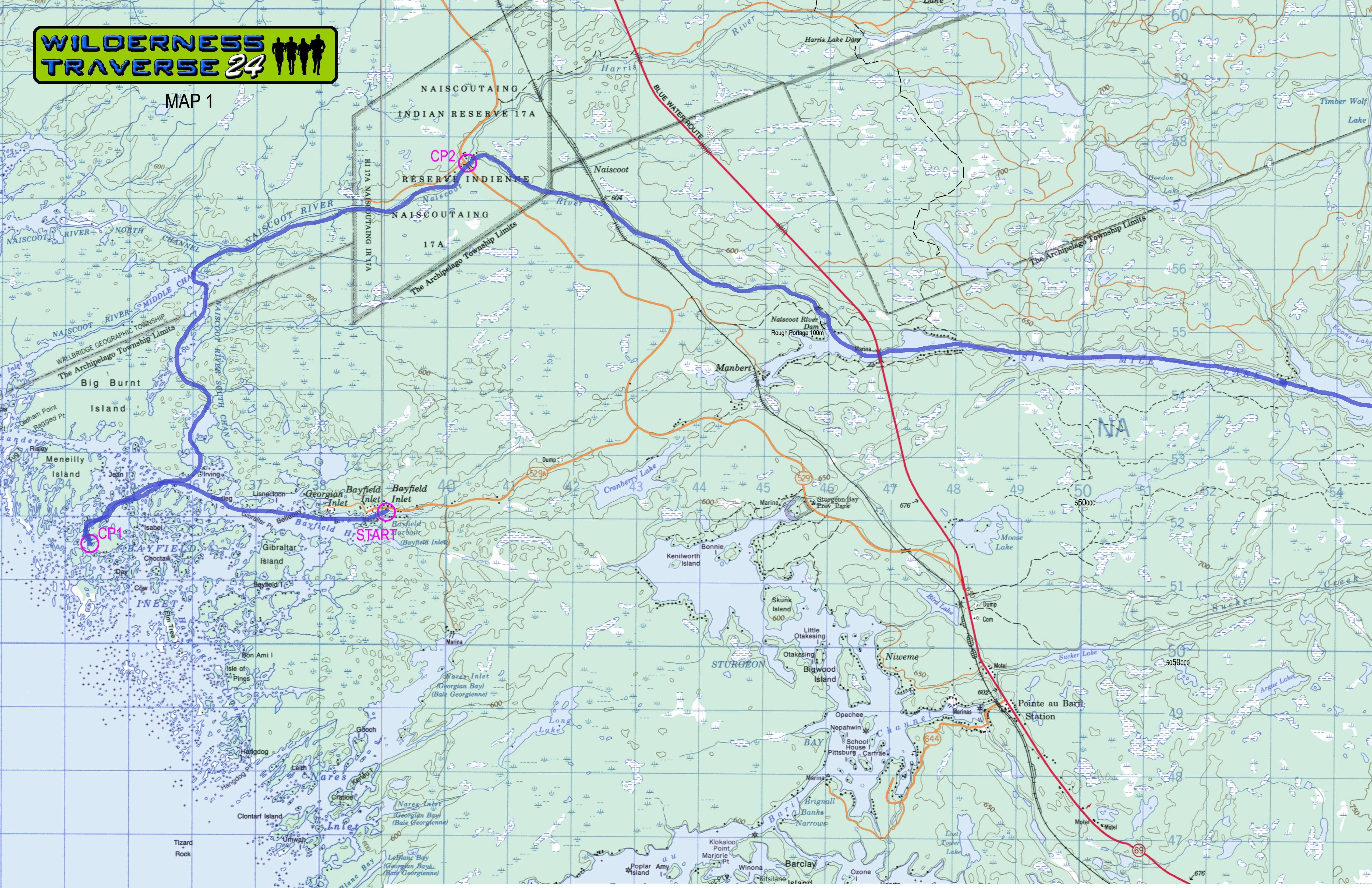
Annotated Map 1
The first section of the first leg of the race was meant to put water navigation to the test, as it featured a canoe paddle amongst thousands of tiny islands to pick out a ‘needle in a haystack’ with a CP on one of the islands. You could either pick a direct route, or use a ‘handrail’ by sticking closer to the mainland and having visual cues of where to turn. We had chosen the ‘safe’ route as shown above (click to see full size), but unfortunately had our boats improperly balanced. Nat and I were in one boat, and James and Harper in the other. They were the stronger boat, so we had mismatched speeds. We arrived at CP1 to see many other teams had grabbed it and were on their way to the next CP already! Oh well, chasing from the  back is easier, right? The full splits had us as 14th to arrive there!
We also delayed further at CP1 by shuffling the boats, now putting James and I in one boat, and Nat and Harper in the other. We all agreed it was ‘hammer time’, and set our goals on re-capturing the front of the race. With speed balanced out better, and fire in our paddles, we raced off. In short order, we had passed a number of teams, and were continuing to pull ahead. We then got a break further into the paddle when all the lead teams got tripped up in a ‘blind bay’ where the route back out to a river we wanted to follow was not obvious. We saw all the leaders, and even compared notes before we all set off en masse again.
We noted that Benoit (Team O-Store) and his crew opted to take a gamble and try for a portage rather than look for a tributary. However, we saw them just as we were actually starting the completely navigable stream, which in theory should help us. We traded paddle strokes with the other leaders, including the teams that had arrived at CP1 in 1st and 2nd. By the time we hit CP2, we were sitting in 4th overall, and held that placement until the first transition, where we were gearing up for the trek. All told, after the initial delays, we were pretty pumped with our position, especially knowing that our strength is in the trekking leg, which is what we were about to tackle. To buoy us even further, O-Store was still on the water, and we were leaving transition just as they were arriving. Their portage idea had hurt them, but they pushed hard to make up time.

Stage 2: Trekking

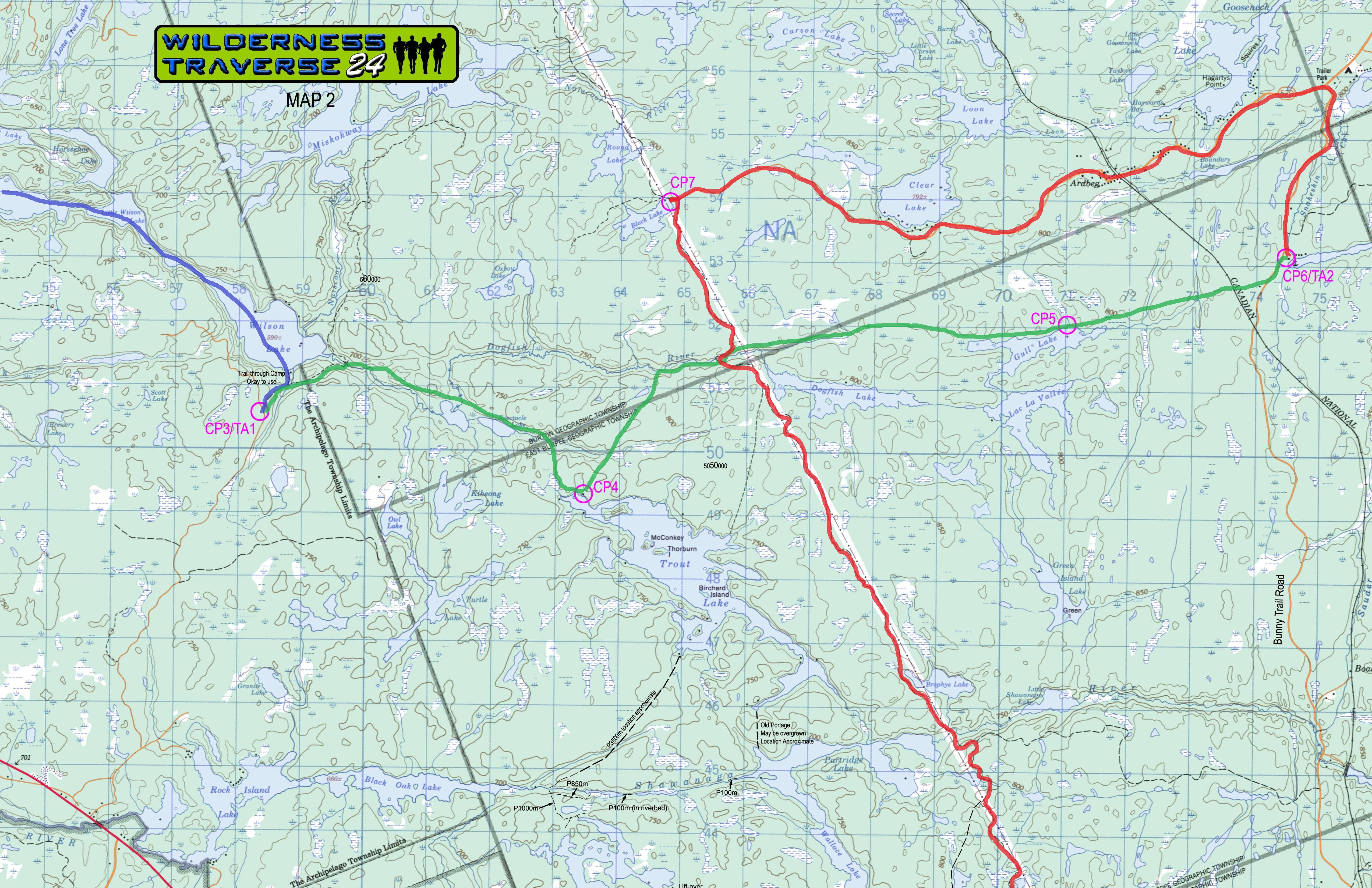
Annotated Map 2This section was where we knew we could pull ahead of many of the chasing teams by pulling off a solid trek. On the water, there is not much room to get ahead, as all teams are limited by hull speed on boats, as well as limited route options. With only 1 real portage, it had been just a straight up paddle. However, on the trek, there are many route options, and teams all have very different speeds when traversing real bush. We are fast on our feet, and have a top navigator to guide us. With over 20km of bushwhacking ahead of us, a LOT can happen.
We set to work on this section with a vengeance, with Harper leading the charge on a mission. Our first CP was a nice remote checkpoint where the staff had actually arrived by float plane on the lake! We crashed out of the woods to find out we were now sitting in 2nd place, and had arrived less than 10 minutes behind first place. We also learned that O-Store were now the team we were chasing! Yes, Benoit, the AR trekking legend, was working his magic once again and his team had completely overcome their earlier paddle snafu. As you’ll see, this is the theme that would define the rest of this race. O-Store in 1st, with use chasing hard, and a slightly longer gap behind us for 2 teams battling it out for 3rd.
The terrain had been [relatively] forgiving on the trek. Sure, we hit a number of swamps, but the bush itself was not super thick, which meant we were able to maintain a very good pace. At the end of the trek, Nathalie informed us this was the fastest  she had ever moved through a bushwhack in a race. From CP4 to CP5, we veered NE to look for some features, deviating from the proposed ‘ideal route’ we saw later, which was a more easterly route. It resulted us in hitting a river, and following it for a while before catching on to an ATV trail that we’d revisit on the bike. Harper noted that we hit the river much further west than he’d hoped, but on arriving at CP5, and looking at the stats, I would say that didn’t hurt us, as we were holding steady at 2nd place, under 10 minutes behind O-Store. More notably, for the trek between CP4 and CP5, we were a mere 24 SECONDS slower than O-Store! That is an amazing stat for a race where you are literally crashing through the bush and everyone takes a slightly different route, hitting swamps, deadfall, etc.
The final leg of the trek was a straight bushwhack between CP5 and CP6/TA2. There were no good features or possible trails, so we just got to work on it. With more solid footwork, we emerged at the transition zone to see O-Store still there, with Benoit actually sitting down eating and resting. Imagine their surprise at seeing us so close! We had been only 2 minutes slower than them, and emerged still a mere 10 minutes behind them!  They left in a hurry, but not fast enough, as we had a smell of blood! We pulled off a remarkably fast transition for trek to bike (fastest, at under 11 minutes), and left the peace of the transition zone now a mere 5.5 minutes behind the leaders.
Now, allow me to whine for just a moment about this type of racing. Transition zones, especially between two long legs, are a great chance to fuel up, change, and recharge. However, when you are racing at the level we were here, it is sheer panic and pandemonium. We are going through everything like a well-oiled machine, but you have to forego things like eating and sitting for a moment. O-Store had spent over 16 minutes in this transition, and the slower teams? They spent over 45 minutes there! Obviously, this is what you HAVE to do to be competitive, but inhaling two poptarts in 30 seconds is an impressive feat, but starting the bike with a mouth full of dry pastry and still putting gloves on can be a bit of a mental challenge! I seriously questioned whether I rather this kind of race or the more relaxed pace I had experienced at Untamed New England. Perhaps something in between?

Stage 3: The ‘Hydro Line’ Bike

Man oh man, what can I say about this leg of the race. It was by far the mentally most difficult, and technically pretty challenging as well. We were lucky, as we did 3/4s of this section of the race with daylight, and in dry conditions, but it was still a HELL of a slog! The beginning of this section was easy enough. About 12km of clear road riding.  We formed a paceline, and just hammered. arriving at the next CP still about 9 minutes behind O-Store. Unfortunately, we were aware that the next, and super-long section of biking could be our weakness. As a team, we knew we’d be slower on the technical power line section than O-Store. We were also unsure how far our nearest competitors were, nor how fast they may be. All we could do was push hard, and maintain our pace.
We literally spent much of this leg glancing behind our shoulders, expecting to get passed at any point. Our nerves were also severely tested by a completely unforeseen foe. DEERFLIES! OMG. I have no words for what these bastards did to our spirits. Even Steely Harper completely lost his shit with them. Our speed was simply not fast enough to out-run them, and they kept flying directly into the vents on my helmet, eating chunks of my ‘head buffet’ as I battled the tricky riding, with both hands on the handlebars. All 4 of us were unanimous in our loathing. In a tough race, you do your best not to complain or be negative, but this was simply too much for us, and we basically were all whining like little babies, at times cursing at the top of our lungs at these buggers. Harper said he had NEVER experienced bugs this bad in ANY race he’d done (hint: he’s done LOTS, including in jungle climes).
Ok, rant over. The point is, the riding was tough, our going felt painfully slow, the trail was long, the terrain endlessly undulating, and our nerves shot from the bugs, AND spirits worried that we’d be passed at any moment. The hallelujah moment was at the next CP, where we were STILL in 2nd place, albeit trailing by almost 45 minutes :-(. This wasn’t the end of the bike though, and we were now continuing on in the dark, and the rain, for the final push to the next transition zone.  Without the bugs though, this didn’t seem quite as miserable (yes, even in the rain). It was about another 12km of ATV trail riding.
On the closing kilometers of the bike, we passed by a slightly tired-looking team O-Store, who were starting the next trekking section. We knew the transition wasn’t too far ahead, and this lifted our spirits, knowing they were not super far ahead of us. They were also WALKING which had us surprised. Emerging at the TA, we discovered why. Apparently, Benoit was having some GI issues, and was periodically ill. Small blessing for us I suppose. By executing another blazing transition (over twice as fast as O-Store), we managed to leave that transition about 30 minutes behind O-Store, and not willing to give up the victory just yet.
Stage 4: Final Trek and Bike
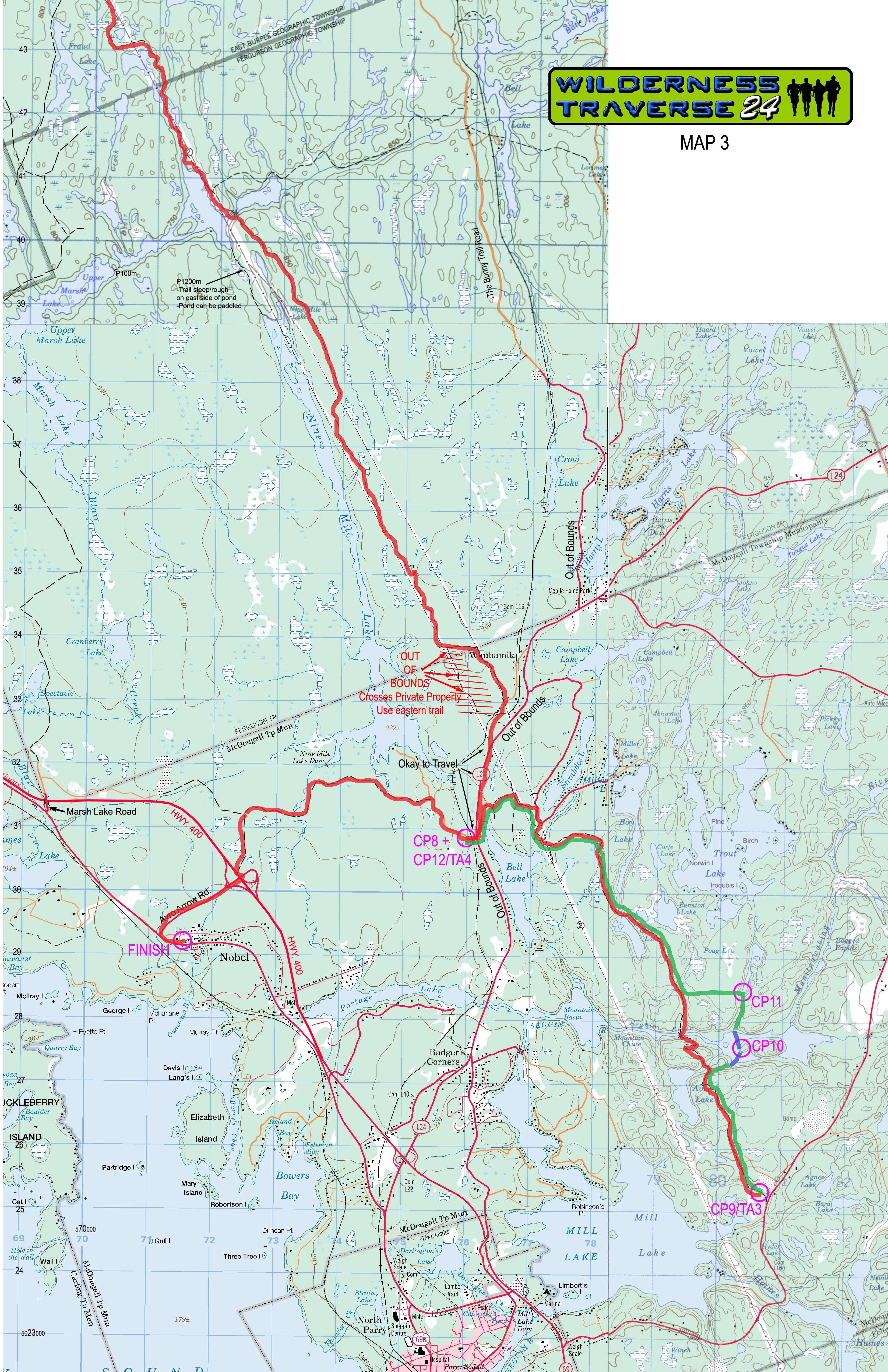
Annotated Map 3
Well, this is it! The final push, and location of yet another ‘close call’ for Mr. ‘Zero percent body fat’ Meyer. We left that transition running hard. So hard that we momentarily set off on the wrong trail. D’Oh! We recovered quickly, but were annoyed at this trip-up. Our plan was to run the entire section where possible, in the hopes of closing the gap to O-Store, and ensuring we kept the 3rd place team safely at bay. Unfortunately, they did to us the exact same thing we had done to team O-Store. Namely, we crossed paths with them at nearly exactly the same place O-Store passed us. This meant we only had about 30 minutes on them too! Damn! That meant we had to keep pushing hard, in spite of starting to feel the effects of a long day racing at 100% output.
At this point, it was raining, but nothing too hard yet, so the terrain wasn’t too bad. For this section, we had about a 10-12k trek to pull off before the final bike leg. As part of the trek, we also had the ‘option’ to swim to a couple checkpoints rather than taking a long trek around. Of course, it wasn’t really an ‘option’ for us, as we knew we had to do this to keep the pressure on. Armed with that knowledge, I had put a dry shirt and rain paints and raincoat in a dry bag in my pack with the intention of changing directly after our swim.
We made good time on the lead-up to the swim, and wasted very little time in ‘taking the plunge’. Our progress was only slightly nerve-wracking in the fact that we were tackling this in the depths of the darkness. Although it was supposed to be a full moon, the rain and clouds meant no visibility. Luckily, the volunteers at one CP had lit a fire, so we essentially had a beacon for the first swim.  The distance was likely around 300m. Had we had daylight, I suspect we could have chosen a spot just a bit further that would have made that 200m. Regardless, off we went, swimming out little hearts out.
Unfortunately for me, I started cramping about halfway into the swim. These were leg cramps that I couldn’t get massaged out. I have to be honest, this was a bit frightening, as we had no flotation, and not a lot of chance for any sort of rescue, so I knew I had to suck it up. Luckily, my years of swim lessons (and lifesaving lessons!) kept me relatively calm, and I just focused on using my arms only. It made for slower progress, but I got there. Once at the CP, I hopped out to take a minute to attempt to massage out the cramps, before we hopped back for the next swim.
Harper estimated this swim at 100m, but in reality, it was as long as the first, and I guess 300m.  Looking at the maps, it was painfully clear that we *could* have cut that to between 50 and 100m by going a little way around the point, but in the darkness, we opted to just head straight towards our landmark, which was a stream on the other side. By the time we hit the far shore, I wasn’t the only one getting a big cold, and we took the time to ensure we’d stay warm for the next bit. For me, that meant stripping off a layer on top and bottom, and swapping out for a dry shirt and putting on my rain gear. I instantly felt better. Well, except for my legs, which were left rather sore from the cramping. I wolfed down as much food as I could while everyone else finished getting set. Then off we went, back in pursuit.
This bit wasn’t too bad, and we managed to hit a good stream that took us basically straight to the final trekking CP. Elated with that, we bushwhacked quickly back to the ATV trail which we’d follow back to the road. Guess what we did once there? Yup, RUN. Ugh. I was feeling pretty beat, but didn’t dare say anything, and just joined in. Within a very short time, I was then overheating with the extra layers, AND had to have a nature break, but had nary time to deal with either. Eventually, James helped by carrying my pack while I peeled off my jacket and pants WHILE RUNNING. It was tricky, but allowed us to not lose much time. For the nature break, try as I might, I was unable to do the ‘running pee’, and eventually pulled off, did my business, then had to run twice as fast to catch back up. Double ugh. But, these are the things you HAVE to do to win. We were also paranoid that team Epitact from France would emerge behind us at any time.
This effort did net us the fastest split on the final run from that CP to the transition, and ready to mount up on our bikes for the final push. On arrival at that TA, we learned that O-Store was still exactly 30 minutes ahead of us. D’oh! Apparently they found their mojo again. The final leg was a biking leg, and was supposed to only take about an hour, which meant catching them would likely not be feasible. Despite that, we left quickly, in order to keep a gap on 3rd place. At that point, we had no way of knowing they’d eventually fall over 1.5 hours behind us at that transition! Soggy and tired, we mounted our bikes, and pedaled off into the darkness, aware there was one final ATV section, before grabbing roads to the finish.
This final ATV section is where something interesting happened. THE SKIES OPENED UP! And I mean sheet rain. It was the heaviest rain we’d ever raced through in Ontario, and it lasted. Not just 5 minutes, but for HOURS! Knowing O-Store was probably out of the ATV section by then, we were totally sunk. We had to navigate the final bits of the race in rivers that were forming on the trail. Eventually all we could do was laugh. We knew everyone else was stuck in the same shit, so it would be a great equalizer, and guarantee our placing basically. Luckily, it wasn’t too cold.
Emerging at the 400, all we had to do was jump on the access road to town, and ride the big hill back to the finish area. Our time on this section was the worst of the 4 teams that eventually actually did it (only the top 4 teams did the full course including this ATV section, the rest of the ‘full course’ teams were allowed to go by roads the whole final section. We lost another 15 minutes on O-Store, meaning we finished off 45 minutes behind them at the finish. Despite this, they all told us this was the hardest they had to race to ensure their victory in this race in their last few years, which made me feel pretty good. They were nice enough to still be up to greet us. Apparently they had been quite surprised to see us in the transition zones where they did. We gave them a good run for their money (both figuratively and literally, given the $1500 cash prize on offer!).
When all was said and done, we’d raced nearly 21 hours non-stop at full throttle, and had a great result to show for it. All our gear and nutrition worked perfectly in this race, so big shout out to all our various sponsors and supporters (Xact Nutrition2XUNorth FaceNuunMilk2Go Sport, and Osprey Packs popping into mind right away). 3rd place was another 1.5 hours behind us, and 4th place another 1.5 hours behind them! Amazing race. Undoubtedly, much of this likely had to do with the extreme rain that had taken over the course. As we went to sleep for a couple hours, it was insane how heavy the rain was falling down.]
Once we were back up, we dealt with gear, had a first breakfast, then a BBQ lunch, and finally the awards ceremony, and time to catch up with our fellow competitors. All agreed that this was yet another epic Wilderness Traverse for the books. Bob always puts on a great race, and it seems every year, the weather also plays a starring role. We’re already looking forward to returning next year for another run at Bob the Beaver (the winner’s trophy). But till that time, there’s still lots more racing. For me, next up is the Bruce Peninsula Multisport Race, which I’m really looking forward to. For that one, I’ll also be filming, so keep your eyes open for that report! Till then, hope everyone is having as much fun this summer as I am!
Steve